-
Carbs Are Not the Enemy. Energy Mismanagement Is.
“Carbs make you fat.”
It sounds decisive. It feels scientific. It gives you something clear to remove.
It is also incomplete.
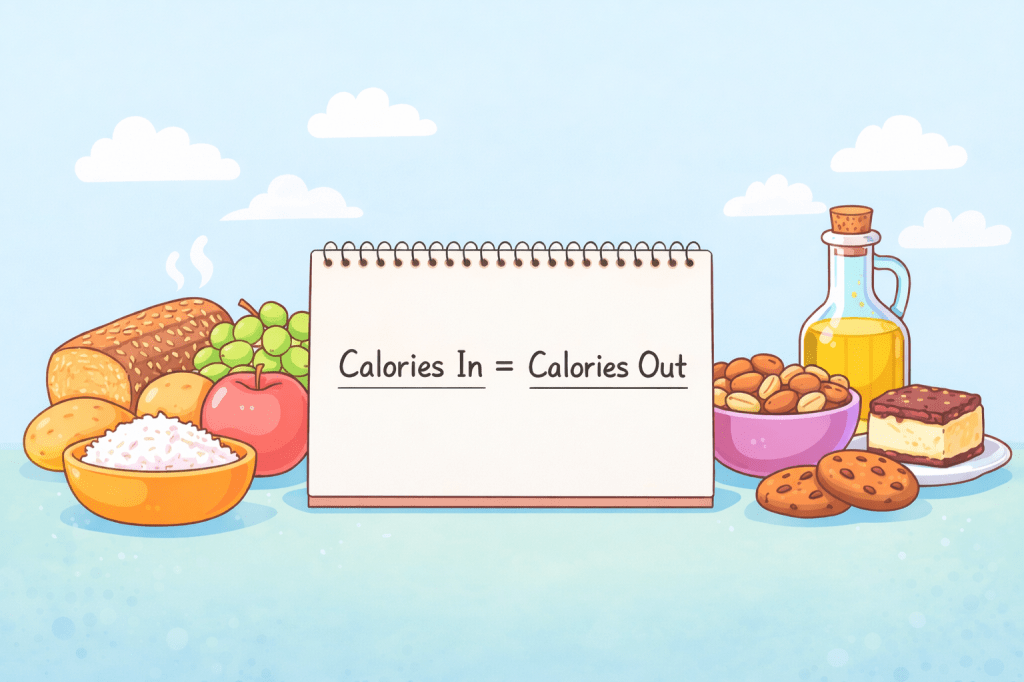
Carbohydrates do not cause fat gain. Chronic energy surplus does.
Carbs became the villain because they are visible, measurable, and easy to blame. Bread is obvious. Rice is obvious. Sugar is obvious. Total energy balance is not. You can point to a plate of pasta and identify the problem. You cannot point to the accumulated energy imbalance of an entire week with the same clarity.
So carbs became the scapegoat. And an entire industry built itself around that narrative.
Why the Belief Feels Logical
The argument usually goes like this:
Carbs raise blood glucose. Insulin rises in response. Insulin reduces fat breakdown. Therefore, carbs cause fat storage.
On the surface, that chain is clean. It has a beginning, a middle, and an end. It feels like cause and effect. It gives you a mechanism. And mechanisms feel scientific.
But short-term fat storage is not the same as long-term fat gain.
Insulin does temporarily reduce fat breakdown. That is normal physiology. It is the body’s way of prioritising the incoming nutrients rather than mobilising stored energy at the same time. Insulin also allows muscles to store glycogen and use nutrients efficiently. It directs amino acids into muscle tissue. It supports recovery.
Over a full day, what matters is not whether fat storage occurs at a single meal. It is whether total energy intake consistently exceeds energy expenditure. Because if you store fat after a carbohydrate-rich meal but burn it off later when insulin drops, net fat balance remains unchanged.
The body is dynamic, not frozen in one hormonal snapshot.
Simple cause-and-effect thinking is appealing because it removes complexity. It gives you one variable to control. One thing to fear. One thing to eliminate. But fat gain is governed by accumulated energy imbalance, not one hormone spike.
What Actually Governs Fat Gain
Fat gain occurs when energy intake chronically exceeds energy expenditure. That is the fundamental mechanism. Everything else, insulin, meal timing, and macronutrient composition, is secondary.
Carbs can contribute to energy surplus. So can fats. So can excess protein, though protein is harder to overconsume due to its satiating effects and higher thermic effect.
In controlled feeding conditions where calories and protein are matched, higher-carb diets do not automatically produce more fat gain than lower-carb diets. Studies comparing low-carb and low-fat diets with equal calories show similar fat loss outcomes. Insulin regulates nutrient flow. It does not override energy balance.
This does not make carbs magical. It makes them neutral. They are a macronutrient. A source of energy. A tool. Not inherently fattening. Not inherently slimming. Just fuel.
Carbs and Performance
Carbohydrates are stored as glycogen in muscle and liver tissue. Glycogen fuels high-intensity training. Sprinting, lifting, interval work, and anything that demands rapid energy production rely heavily on glycogen.
Adequate carbohydrate intake supports training quality, volume, and recovery. When glycogen stores are full, you can train harder, recover faster, and sustain higher outputs over time.
When carbs are aggressively reduced, performance often drops. Training intensity declines because glycogen stores are insufficient to fuel hard efforts. Total work decreases because you fatigue faster. Over time, body composition progress may stall, not because you are eating carbs, but because your training stimulus has declined due to inadequate fuel.
For athletes and serious trainees, carbs are not an optional decoration. They are functional fuel. Cutting them to chase fat loss often backfires because the training quality that drives body composition improvement deteriorates.
Why Low-Carb Diets Sometimes Work
Lower-carb approaches can be effective. This is not a defense of high-carb diets as universally superior. Context matters.
Low-carb diets work for some people because they reduce food choices. Fewer options mean fewer decisions. Fewer decisions mean less opportunity to overconsume.
They increase satiety for some people. Protein and fat are more satiating than refined carbohydrates for many individuals. A meal of eggs and avocado may keep you full longer than a bowl of cereal, even if calories are similar.
They simplify decision-making. Cutting carbs creates a clear rule. No bread. No pasta. No rice. Rules are easier to follow than nuanced energy management.
The result is often lower total energy intake. Not because carbs were fattening, but because removing them created structure that led to better energy control.
The mechanism is not carb removal itself. It is improved energy control through the structure.
That distinction matters. Because if you do not understand why low-carb works, you cannot troubleshoot when it stops working. And it will stop working if you compensate by overeating fats and proteins, which many people do.
Trade-Offs, Not Morality
Higher-carb diets often support better performance and recovery. They may be easier to sustain for active individuals who enjoy training hard and want the fuel to support it. They allow for more food variety and social flexibility.
Lower-carb diets may help certain people manage appetite and adherence. They may indirectly reduce calories by limiting food choices. They may improve metabolic markers for individuals with insulin resistance or type 2 diabetes.
Neither approach is morally superior. Carbs are not virtuous. Low-carb is not virtuous. The question is context, lifestyle, and training demands.
If you are sedentary, insulin-resistant, and struggle with hunger on higher-carb diets, lower carbs may serve you well. If you are training five days a week at high intensity and find that low-carb leaves you exhausted and weak, higher carbs make sense.
The best diet is the one you can follow consistently while supporting your goals. Not the one that aligns with an ideology.
Coaching Reality
In practice, people who blame carbs often under-report total intake. They focus on the obvious carbs, bread, rice, pasta, while ignoring the oils used in cooking, the snacks consumed mindlessly, and the weekend meals that quietly push calories above maintenance.
They cut carbs and lose weight initially. Then fat loss stalls despite continued low-carb intake. They assume their metabolism is broken or that they need to go even lower. The reality is often that total energy remains high. The carbs were replaced with fats or larger portions of protein. Energy balance did not shift enough to sustain fat loss.
On the other side, athletes restrict carbs unnecessarily and wonder why performance and recovery suffer. They blame age, stress, or poor programming. They do not realise that their bodies simply do not have the fuel to support the training demands they are placing on them.
Energy mismanagement hides behind carb elimination. People think they are solving a macronutrient problem when they are actually avoiding an energy problem.
What to Stop Doing
Stop fearing single macronutrients. Carbs are not poison. Fat is not poison. No single food or macronutrient causes fat gain in isolation. Energy imbalance does.
Stop equating insulin spikes with inevitable fat gain. Insulin is not the enemy. It is a regulatory hormone. It does its job. If you are in energy balance or deficit, insulin spikes do not cause fat accumulation.
Stop cutting carbs while ignoring total intake. You cannot eat unlimited fats and proteins and expect fat loss just because you removed carbs. Energy still matters.
Stop wearing low-carb as a badge of discipline. Dietary choices are tools, not moral statements. You are not more disciplined for avoiding carbs. You are following a strategy that may or may not serve your goals.
What to Focus On Instead
Focus on total energy intake over time. This is the variable that governs body composition. Track it. Manage it. Adjust it based on progress.
Ensure adequate protein. Protein supports muscle retention, satiety, and recovery. It is the one macronutrient that should be prioritised regardless of whether you eat high-carb or low-carb.
Train with intent and quality. Your training creates the stimulus for body composition change. Fuel it appropriately. Do not sabotage training quality by under-fueling in the name of cutting carbs.
Eat enough fibre and whole foods. Regardless of macronutrient split, prioritise nutrient density. Vegetables, fruits, and whole grains, if you eat carbs, quality fats, and lean protein,s should form the foundation.
Match carbohydrate intake to activity level. If you train hard, eat more carbs. If you are sedentary, eat less. This is not complicated. Fuel matches demand.
Choose an approach you can sustain without obsession. If low-carb feels restrictive and makes you miserable, do not force it. If high-carb makes you feel sluggish and constantly hungry, adjust. The best approach is the one you can follow long-term without constant mental negotiation.
Body composition is not determined by one nutrient. It is determined by repeated energy decisions. Hundreds of meals over months and years. Not one macronutrient choice.
The Identity Shift
Move from “Carbs are bad” to “Energy management determines body composition.”
Move from food fear to food strategy. Stop treating macronutrients as moral categories. Start treating them as tools with specific functions.
Carbohydrates are a tool. They can be overused. They can be underused. They are not the enemy.
Mismanaged energy is.
The person who understands this can eat carbs, enjoy food, train hard, and make progress. The person who does not understand this will keep cycling through elimination diets, blaming macronutrients, and wondering why nothing works long-term.
The difference is not carbs. The difference is understanding what actually drives body composition change: energy balance, training stimulus, consistency, and time.
Carbs are just one variable in that equation. And not even the most important one.
-
Why Being Fit Does Not Automatically Mean You Are Healthy

We tend to treat fitness as proof of health. If someone looks lean, trains hard, runs fast, or lifts heavy, we assume their body is thriving. The assumption feels intuitive. Performance is visible. Health is not.
That shortcut is convenient, but it is also misleading.
You can be fit and unhealthy at the same time. You can run a marathon while being chronically inflamed. You can have visible abs while your hormones are dysregulated. You can set personal records in the gym while your nervous system is quietly burning out.
The disconnect between fitness and health is one of the most misunderstood concepts in modern training culture. And the confusion is not just semantic. It has real consequences for how people train, recover, and think about their bodies.
The Core Misconception
The most common mistake is treating fitness and health as interchangeable. They are not the same system. They do not measure the same things. They do not even serve the same purpose.
Fitness is the ability to perform a task. It is specific, trainable, and measurable. How fast can you run? How much can you lift? How long can you sustain effort? These are fitness questions. They have clear answers.
Health is the capacity to sustain life, adapt to stress, and recover over time. It is broader, more complex, and harder to quantify. Can your body handle disruption without collapsing? Do your systems maintain balance under pressure? Can you recover from illness, injury, or stress without lingering dysfunction? These are health questions. The answers are rarely simple.
Fitness answers the question: What can you do right now?
Health answers a different one: What can you keep doing without breaking down?
The distinction matters because optimising for one does not guarantee the other. In fact, optimising too aggressively for fitness can actively erode health if the process ignores recovery, energy availability, sleep, and stress management.
Confusing the two leads people to optimise the wrong variables. They chase performance markers while their underlying systems quietly deteriorate. They celebrate outputs while ignoring inputs. They mistake the ability to push hard for the capacity to sustain that effort over time.
Why This Belief Persists
People believe fitness equals health because performance and aesthetics are easy to measure. You can time a run, count reps, track weight lifted, or see abs in the mirror. These markers feel objective and reassuring. They give you something concrete to point to, something you can post, something you can compare.
Health markers are quieter. Sleep quality, hormonal stability, immune resilience, injury recovery, and mental bandwidth do not announce themselves on social media. They reveal themselves slowly, often only when something starts to fail. You do not notice your cortisol is chronically elevated until you stop being able to sleep. You do not realise your immune system is compromised until you are sick for the third time this month. You do not see the warning signs until they become problems.
There is also a cultural bias at play. Discipline and suffering are celebrated. Rest, restraint, and sustainability are not. When someone trains relentlessly and looks impressive, we reward the output without questioning the cost. We admire the dedication, the work ethic, and the visible results. We do not ask about sleep quality, stress levels, or how they feel when they are not in the gym.
This creates a feedback loop. People pursue what gets rewarded. What gets rewarded is visible performance. So people push harder, train more, sacrifice recovery, and tell themselves they are doing the right thing because their fitness markers are improving.
Meanwhile, the systems that actually determine long-term health, the hormonal regulation, the immune function, and the nervous system resilience, are quietly eroding. And no one notices until something breaks.
What the Evidence Actually Shows
When you look beyond surface-level performance, health becomes a broader and less glamorous concept.
Health includes recovery capacity between stressors. Not just whether you can handle one hard workout, but whether you can handle five in a row and still adapt. Whether you can train hard one day, sleep well that night, and wake up ready to do it again without accumulating fatigue that never clears.
Health includes hormonal balance, not just body composition. You can be lean and have terrible hormonal function. Low testosterone in men, menstrual irregularities in women, thyroid dysfunction, and chronic cortisol elevation, these do not show up in body fat percentage. But they show up in energy levels, mood stability, libido, recovery capacity, and long-term metabolic health.
Health includes low injury risk across years, not peak weeks. Anyone can stay injury-free for a few weeks or months by pushing through pain and ignoring warning signs. Health is about staying injury-free across years and decades because your training respects your body’s limits and builds durability instead of exploiting fragility.
Health includes nervous system stability, not constant activation. If you are always in fight-or-flight mode, if you cannot relax, if your resting heart rate is elevated and your heart rate variability is low, your nervous system is not healthy. It is stuck in overdrive. That might allow you to perform in the short term, but it breaks you down over time.
Health includes the ability to absorb life stress without collapsing. If your training is so demanding that any additional stress, a work deadline, a relationship conflict, or a poor night of sleep causes everything to fall apart, you are not healthy. You are operating on the edge of dysfunction with no margin for error.
A person can be highly fit and still be inflamed, sleep-deprived, hormonally dysregulated, and mentally exhausted. None of that shows up in a personal record. None of it prevents you from posting an impressive training session. But all of it matters for long-term health.
This is not a fringe idea. Overtraining syndrome, chronic fatigue, recurrent injuries, and burnout are common in people who appear “fit” by external standards. These are not rare edge cases. They are predictable outcomes of treating fitness as the only variable that matters.
The Trade-Offs We Ignore
High fitness often coexists with poor sleep, chronic stress, low energy availability, and fragile recovery. These trade-offs are frequently normalised or even glorified. “No pain, no gain.” “Rest is for the weak.” “Sleep when you’re dead.”
These are not motivational mantras. They are rationalisations for unsustainable behaviour.
The problem is not intensity itself. Intensity is a useful training tool. The problem is intensity without margin. When your system is always pushed to its limits, you lose resilience. Small disruptions hit harder. Missed sleep matters more. Minor injuries linger. Motivation becomes brittle instead of stable.
At that point, fitness becomes something you must constantly defend rather than something that supports your life. You cannot afford to miss a workout because your body has adapted to the stress and now requires it to maintain equilibrium. You cannot take a week off without feeling anxious because your identity is tied to performance outputs. You cannot handle a disruption to your routine without everything unravelling.
That is not healthy. That is dependence.
True health creates margin. It allows for disruption without collapse. It builds systems that can absorb stress, adapt, and return to baseline without requiring perfect conditions. It does not demand that everything go right. It functions even when things go wrong.
What to Stop Doing
Stop using performance as a proxy for health. Just because you can run faster or lift heavier does not mean your body is healthier. Performance is one data point. It tells you about your ability to execute a task under specific conditions. It does not tell you about your hormonal health, immune function, nervous system resilience, or long-term capacity to sustain that performance.
Stop assuming that because training numbers are improving, the system underneath is coping well. Performance can improve even as health deteriorates. Your body will often give you what you ask for in the short term, even if it is borrowing from resources you cannot afford to lose. You can set PRs while your cortisol is chronically elevated, your sleep is terrible, and your immune system is compromised. The performance improvement does not mean you are getting healthier. It might mean you are getting better at tolerating dysfunction.
Stop treating fatigue, poor sleep, and recurring pain as the price of being “serious.” These are not badges of honour. They are warning signs. Fatigue that does not resolve with rest is not normal. Sleep that is consistently disrupted is not something to push through. Pain that keeps coming back is not something to ignore.
These habits do not signal commitment. They signal misalignment. They indicate that the demands you are placing on your body exceed your capacity to recover from them. And if you keep ignoring that signal, the body will eventually force the issue through injury, illness, or burnout.
What to Start Focusing On
If health is the goal, the metrics change. The variables you track, the outcomes you value, the questions you ask, all of it shifts.
Start paying attention to how quickly you recover, not how hard you can push. Can you train hard and feel ready to train again within a reasonable timeframe? Or do you need days to recover from a single session? Do you wake up feeling restored, or do you wake up feeling like you need more sleep, no matter how much you got?
Recovery speed is a better indicator of health than peak output. If your recovery is fast and consistent, your body is handling the stress well. If recovery is slow and unpredictable, something is off.
Start valuing consistency across months and years, not peak output. Anyone can have a great week. Health is about having many okay weeks that add up to something meaningful. It is about being able to train regularly without constantly battling fatigue, injury, or illness. It is about showing up consistently because your body can handle the load, not because you are forcing it to.
Start tracking energy levels outside the gym, not just inside it. How do you feel when you are not training? Do you have energy for work, relationships, hobbies, and life? Or is all your energy consumed by training and recovery, leaving nothing for anything else?
If your training improves your gym performance but depletes your capacity to function in the rest of your life, that is not health. That is narrow optimisation at the expense of overall well-being.
Start noticing how your body responds to stress, illness, and disruption. When you get sick, do you recover quickly, or do illnesses linger? When you get injured, does it heal in a reasonable timeframe, or do minor issues become chronic? When life gets stressful, does your body handle it, or does everything fall apart?
Resilience under disruption is a core feature of health. If your system only works under ideal conditions, it is fragile.
Health is not about maximising output. It is about maintaining capacity. It is about building a body that can do what you need it to do, not just today, but next year, and ten years from now.
The Necessary Identity Shift
This requires a more profound shift than simply changing training variables. It requires rethinking what you value and how you define success.
Move from the identity of a “high performer” to that of a “durable human.”
A high performer asks, How far can I push today? What is the maximum effort I can sustain? How much can I extract from my body right now?
A durable human asks, What can I sustain without erosion? What load can my body handle repeatedly without breaking down? How do I build capacity that lasts?
Durability is no less ambitious. It is more intelligent. It values longevity over spectacle, resilience over aesthetics, and adaptability over control. It recognises that the ability to perform once is less valuable than the ability to perform consistently. It understands that looking impressive is less important than feeling functional.
Durability does not reject intensity. It contextualises it. It uses intensity strategically, not constantly. It builds margin so that when you do push hard, your body can handle it and recover.
A durable human is not someone who avoids challenge. It is someone whose body is robust enough to meet challenges without breaking down in the process.
The Bottom Line
Fitness is a tool. Health is the system that allows you to keep using it.
Fitness measures what you can do. Health measures what you can sustain. Fitness is about performance in a moment. Health is about capacity over time.
You can have one without the other. You can be fit and unhealthy. You can be healthy and not particularly fit. Ideally, you want both. But if you have to choose, health is the foundation. Without it, fitness becomes a house built on sand.
Confusing the two is not just an intellectual error. It is how people quietly train themselves into fragility while believing they are doing everything right. They optimise for outputs while ignoring inputs. They celebrate performance while their systems deteriorate. They mistake the ability to push hard for the presence of health.
And then, one day, something breaks. An injury that does not heal. An illness that lingers. Fatigue that does not resolve. Motivation that disappears. And they realise, too late, that fitness without health is not sustainable.
So if you are training hard, chasing performance, pushing limits, ask yourself: Am I building fitness, or am I building health? Am I creating capacity, or am I depleting it? Am I getting stronger, or am I just getting better at ignoring warning signs?
Because being fit is impressive. But being healthy is what allows you to stay fit. And confusing the two is how people who look like they are thriving end up quietly falling apart.
Leave a comment
-
Motion Over Motivation: Why Progress Starts Long Before You Feel Ready

Every January, motivation gets romanticised.
People wait for the right mood. The right Monday. The clean slate. The surge of energy that finally makes change feel effortless.
And then they wait some more.
Not because they are lazy. But because they have been taught a quiet lie: that action should begin after motivation arrives.
It does not.
Motivation is emotional. Motion is mechanical. Progress is built by the second, not the first.
Motivation Feels Powerful Because It Feels Good
Motivation is seductive. It comes with clarity, confidence, and urgency. When you feel motivated, action feels obvious. Easy. Almost inevitable.
That is exactly why people trust it.
But motivation is unstable. It fluctuates with sleep, stress, validation, novelty, and mood. It rises when life feels aligned and disappears the moment friction shows up. It is a fair-weather friend, present when you least need it and absent when you need it most.
You wake up energised one morning, ready to tackle everything. Three days later, that same task feels impossible. Nothing about the task changed. Your motivation did. And if your ability to act depends entirely on that feeling, you are building on unstable ground.
If motivation were reliable, the people who talk the most would also execute the most. They do not. The ones with the most inspiring vision boards, the most detailed plans, the most articulate explanations of what they are going to do, often accomplish the least. Because talking about change feels productive. It gives you the dopamine hit of progress without the friction of actually doing anything.
Motivation feels convincing. That does not make it dependable.
The Real Mistake People Make
The problem is not that motivation is useless. The problem is that people treat motivation as a requirement.
“I will start when I feel ready.”
“I just need to get into the right headspace.”
“I know what to do, I just don’t feel like it yet.”
This sounds responsible. It sounds thoughtful. In reality, it is often avoidance with better language.
Because here is the truth: readiness is rarely a cause. It is usually a consequence.
You do not feel ready and then act. You act, and then you feel ready. The confidence comes after the doing, not before it. The belief that you can handle something emerges from the evidence that you have already handled it, even imperfectly, even badly, even once.
Waiting to feel ready is the most socially acceptable form of procrastination.
It lets you delay without feeling guilty. It frames inaction as wisdom. It gives you permission to stay stuck while believing you are being strategic. And the longer you wait, the more intimidating the task becomes, because now you are not just starting, you are starting after all this time spent not starting.
The gap between intention and action becomes a story about who you are. Someone who does not follow through. Someone who talks but does not do. Someone who needs everything to be perfect before they can begin.
And that story, more than any lack of motivation, is what keeps you from moving.
Motion Changes the Order of Things
Most people believe progress works like this:
Belief leads to motivation, motivation leads to action, and action leads to results.
In reality, it works in reverse.
Action leads to evidence, evidence leads to belief, belief leads to identity.
Motion produces feedback. Feedback builds confidence. Confidence changes identity.
You do not act because you believe. You believe because you have acted enough times to trust yourself.
This is not motivational rhetoric. This is how behaviour change actually works. You do the thing once, badly, and you learn that you survived it. You do it again, still badly, and you learn that it gets slightly easier. You do it a third time, and it starts to feel familiar. A fourth time, and you no longer need to convince yourself.
Somewhere in that repetition, the identity shifts. You stop being someone who is trying to work out and become someone who works out. You stop being someone who wants to write and become someone who writes. Not because you declared it. Because you did it enough times that the evidence became undeniable.
Motion does not require emotional permission. It requires a decision.
What Motion Actually Means (and What It Does Not)
Motion is not intensity. Motion is not grinding. Motion is not staying busy to feel productive.
Motion is defined by three constraints.
First, the action is small enough to execute on bad days. Not just good days. Not just motivated days. Bad days. The days when you are tired, distracted, overwhelmed, or discouraged. If your standard requires ideal conditions, it is not motion. It is a performance that only happens when you feel like performing.
Second, the action is repeatable without emotional hype. It does not need a playlist, a pep talk, or the perfect environment. It does not depend on you feeling inspired. It just happens, the way brushing your teeth happens, not because you are excited about it, but because it is simply what you do.
Third, the action moves in a clear direction. It is nota random activity. It is not busy work. It serves a purpose. It compounds. It builds toward something, even if that something is just proving to yourself that you can show up again.
One workout instead of a transformation. One paragraph instead of a book. One walk instead of a reinvention.
Motion works because it bypasses emotion instead of trying to overpower it.
It does not ask how you feel. It does not wait for alignment. It just moves, and in moving, it changes you.
Why Motion Creates Meaning, Not the Other Way Around
A common objection is that this approach feels mechanical. Cold. Devoid of meaning.
But meaning rarely precedes engagement. It follows it.
People do not move because life feels meaningful. Life feels meaningful because it is moving toward something.
You do not wake up one day and suddenly feel that your work matters, and then start working with purpose. You start working, even when it does not feel meaningful, and through that work, meaning emerges. You see progress. You solve problems. You contribute something. And in that contribution, significance is built.
Stillness amplifies doubt. The longer you sit with an idea without acting on it, the more reasons you find not to. The more flaws you see. The more obstacles you imagine. Motion clarifies it. Not because motion answers all the questions, but because it reduces the space for rumination.
When you are moving, you are learning. When you are still, you are guessing.
Meaning is not found in waiting. It is built through movement.
Countering the Sceptics (Without Weakening the Argument)
Let’s address the objections directly, because this idea will be challenged.
“But motivation does start action.”
Yes. Sometimes. Motivation can ignite action. It cannot be trusted to sustain it. Treating motivation as fuel instead of a bonus is where most people fail.
Motivation is useful when it shows up. But if your ability to act depends on it showing up, you are at the mercy of something you cannot control. Motion treats motivation as a pleasant surprise, not a prerequisite.
“What about burnout or depression?”
This argument collapses if motion is misunderstood as force.
Motion is not maximal output. Motion is continuity at an honest capacity. For someone burnt out, motion might mean showing up, not excelling. For someone overwhelmed, motion might mean reducing the goal, not abandoning it.
Motion respects capacity. Motivation ignores it.
Motivation demands you feel good enough to act. Motion asks only that you act within what is sustainable. It is the difference between forcing yourself to run five miles when you are exhausted and allowing yourself to walk for ten minutes. One compound. The other breaks you.
“Isn’t this just robotic living?”
Only if motion lacks direction.
Motion without direction becomes noise. Motion with direction builds momentum. This is not about removing meaning. It is about removing emotion as a gatekeeper.
You can care deeply about what you are doing and still refuse to let your feelings dictate whether you do it. In fact, the things that matter most are often the things you need to do regardless of how you feel about them in the moment.
“Can motion become avoidance too?”
Yes. And this matters.
Staying busy is not the same as moving forward. Motion must serve a direction, not distract from discomfort. Execution without reflection becomes chaos. Reflection without execution becomes stagnation.
The key is honest assessment. Are you moving toward something, or are you moving to avoid sitting with something uncomfortable? Both involve action, but only one creates progress.
The Quiet Advantage of People Who Move Anyway
People who make progress are not more motivated. They are less dependent on how they feel before acting.
They do not wait for alignment. They create it.
They understand something most people resist: emotion is not a reliable decision-making tool.
Emotions are information. They tell you something about your state, your environment, and your needs. But they are not instructions. Feeling unmotivated does not mean you should not act. It just means you feel unmotivated. The decision to act is separate.
This is not cold or detached. It is realistic. It is the recognition that feelings change faster than circumstances do, and if you wait for your feelings to stabilise before you move, you will spend most of your life waiting.
Progress does not follow feeling good. It follows doing what was decided.
The people who change are the ones who decided what mattered when they felt clear, and then honoured that decision even when clarity faded. They built systems that did not depend on inspiration. They lowered the bar for what counted as action so that even on bad days, they could still move.
And in that movement, something shifted. Not all at once. Not dramatically. But consistently. Until one day, they looked back and realised they had become someone different, not because they felt like it, but because they kept moving when they did not.
A Constraint to End On
If you need to feel motivated to begin, you are already negotiating with resistance.
Design actions so small they do not require belief. Remove emotion from the decision to start. Let motion do the psychological work that motivation never could.
Because motivation will come and go. It will rise with wins and disappear with setbacks. It will depend on a thousand variables you cannot control.
But motion? Motion is a choice. And choices can be made regardless of how you feel.
So stop waiting for the right moment. Stop waiting to feel ready. Stop waiting for motivation to carry you.
Just move. Small. Repeatable. Forward.
And let the rest follow.
Leave a comment
-
How to Start the New Year Without Setting Yourself Up to Quit

Every January, the same ritual plays out.
People decide that this will be the year they finally get disciplined. They set ambitious resolutions. They feel motivated. They feel clean. Reset.
And then, quietly, predictably, it unravels.
By mid-February, most of those resolutions are abandoned. Gym attendance drops. Diets collapse. Productivity systems are forgotten. What started as confidence ends as self-criticism.
New Year’s resolutions have failed so consistently that they have become a meme. But that failure is not a personal flaw. It is a design flaw.
You’re not broken. The strategy you were taught is.
Why the New Year Feels Powerful (and Why That’s the Problem)
The New Year feels different because it is a psychological landmark. It creates the illusion of a fresh start.
January 1 feels clean, symbolic, separate from the mess of the past year. That emotional lift is real. Psychologists call it the fresh start effect. It is the reason people feel energised at the start of a new week, a new month, a new season. The brain loves beginnings. They feel like permission to try again.
But here is where things go wrong. The mistake is assuming that emotional readiness equals behavioural readiness.
The calendar changes overnight. Your habits, identity, stress levels, environment, and coping mechanisms do not. January changes the date. It does not change your nervous system.
The emotional high of a fresh start is powerful, but it is temporary. It gives you a burst of optimism that can carry you through the first few days, maybe even the first couple of weeks. But optimism is not infrastructure. It is fuel, and fuel runs out.
When that initial surge fades, and it always does, you are left with the same person you were in December. The same patterns. The same triggers. The same default behaviours that you were trying to escape.
Optimism spikes. Goals inflate. People commit to more than their current systems can support. When friction appears, and it always does, motivation collapses because there was no structure underneath it.
Optimism is not preparation. And a good feeling is not a plan.
The Real Failure Rate (and What It Actually Means)
Studies consistently show that the majority of New Year’s resolutions fail within the first six to eight weeks. By February, adherence drops sharply. Long-term success rates are low. Some research suggests that as few as 8% of people actually follow through on their resolutions.
This is usually framed as a discipline problem. People say things like, “I just don’t have the willpower,” or “I’m not motivated enough,” or “I always do this.”
That interpretation is lazy.
The real issue is not that people quit early. It is that their plan required them not to quit at all.
Most resolutions are built on the assumption of uninterrupted progress. They do not account for disruption, fatigue, stress, or life simply getting in the way. The plan only works if everything goes smoothly. And when does life ever go smoothly?
If your system only works when life cooperates, it isn’t a system.
Miss one workout. Miss one habit. Miss one week. The identity story breaks. Shame replaces curiosity. Avoidance follows. You stop because continuing would mean admitting you are not the person you said you would be.
Failure is not sudden. It is emotional. It happens the moment you decide that missing once means you have failed entirely. The resolution does not collapse because the behaviour is too hard. It collapses because the story you told yourself about who you were going to be cannot survive imperfection.
The Common Mistake Almost Everyone Makes
Most people start the year by making identity-level promises.
“This year I’ll be consistent.” “This year I’ll be disciplined.” “This year I’ll change.”
Identity declarations feel powerful, but they are fragile. You are trying to feel like a different person before you have behaved like one.
This is backward.
Consistency is not something you declare. It is something that emerges from repetition. You do not become consistent and then act. You act, and consistency follows.
When you lead with identity, you set yourself up for a specific kind of failure. Every time your behaviour does not match the identity claim, your brain registers a mismatch. You said you were disciplined, but you skipped the gym. You said you were consistent, but you forgot to journal. You said you were changing, but you are still doing the same things.
The mind protects itself by quitting. If you stop trying, you stop failing. If you stop failing, you stop feeling the dissonance. So you withdraw. You tell yourself it was not the right time, or the goal was not realistic, or you will try again later when things are better.
But the problem was never the goal. It was the order of operations. You tried to be someone before you did the things that person does.
Why New Year’s Resolutions Became a Meme
Resolutions became a meme because the cycle is obvious.
Hope. Overcommitment. Early friction. Quiet collapse.
People recognise themselves in it. Humour becomes a way to soften disappointment. You laugh about the gym being packed in January and empty by February. You joke about buying a planner you never use. You post about how this is the year you will finally stick to something, even though you posted the same thing last year.
Memes do not exist because people are stupid. They exist because patterns are predictable.
When failure becomes a joke, it’s usually because it’s painfully familiar.
The meme is a defence mechanism. It lets you acknowledge the pattern without feeling the full weight of it. But underneath the humour is frustration. Underneath the frustration is the quiet belief that maybe you are just not the kind of person who follows through.
And that belief, more than any lack of discipline or willpower, is what keeps the cycle going.
The Real Meaning of Consistency (This Is Where Most People Get It Wrong)
Most people think consistency means never missing. That belief guarantees failure.
Consistency is not perfection. Consistency is recovery speed.
It is not about maintaining an unbroken streak. It is about how quickly you return after disruption. How many days pass between the moment you fall off track and the moment you get back on. Whether missing once turns into missing a week, or whether you treat it as a single event and move forward.
Consistency is not never missing. It’s returning without emotional damage.
Missing days is not the problem. Letting one mistake turn into a story about who you are is.
This is the difference between people who change and people who quit. The people who change are not the ones who never fail. They are the ones who do not turn failure into identity. They miss a workout and think, “I missed a workout,” not “I am someone who cannot stick to things.”
They do not catastrophize. They do not spiral. They do not let the gap between intention and action become evidence of personal inadequacy. They just start again.
That is the skill. Not perfection. Recovery.
A Practical, Non-Fluffy Framework That Actually Works
If you want this year to be different, you need a different starting point. Not more motivation. Not bigger goals. Not louder promises.
You need proof.
The Proof-First Approach
Most people start with goals and work backwards. They decide what they want to achieve and then try to force themselves to behave accordingly. This approach is fragile because it depends entirely on sustained motivation and willpower.
The proof-first approach flips this. You start with behaviour and let the identity emerge from evidence. You do not declare who you will be. You show yourself who you are becoming through repeated action.
Here is how it works.
Remove identity language. No “new me.” No dramatic transformation narrative. Just behaviour. Instead of saying, “I am going to be someone who works out every day,” say, “I am going to work out three times this week.” The first is a promise. The second is a task.
Start smaller than your ambition. Not to stay small, but to stay repeatable. If you want to write every day, start with one sentence. If you want to exercise, start with five minutes. If you want to read more, start with one page. The goal is not to impress yourself. The goal is to build proof that you can do the thing, even when it feels small and unimpressive.
Define success as returning. The win is not the streak. The win is showing up again after the disruption. If you miss a day, success is getting back to it the next day. If you miss a week, success is starting again without shame or judgment. The faster you return, the more you prove to yourself that this is who you are now.
Expect failure and design for it. Life will interrupt you. Plan for the restart, not the perfect run. Ask yourself, “What will I do when I miss a day?” Not if. When. Have a plan for getting back on track that does not involve guilt or self-punishment. Make returning easy.
Increase only after boredom. Boredom is a signal that the behaviour is stable. Stability comes before growth. If you are still struggling to maintain the habit, do not add more. If it feels automatic, then you can increase the intensity, duration, or frequency. But not before.
Build evidence before you build expectations.
How to Actually Start the New Year
Not with intensity. Not with declarations. Not with pressure.
Start with something quiet. Something repeatable. Something slightly unimpressive.
The changes that last rarely look impressive at the beginning. They do not make good stories. They do not inspire dramatic Instagram posts. They do not feel like a transformation.
They feel like showing up when you do not want to. Like doing the small thing again, even though it does not seem to matter. Like continuing when there is no proof yet that it is working.
January does not change you. Repetition does.
So lower the promises. Reduce the emotional load. Let consistency emerge instead of forcing it.
Do not try to become a different person overnight. Just do one small thing, and then do it again. And again. Until the doing becomes who you are, not because you declared it, but because you proved it.
That is how real change starts. Not with a resolution. With a choice, made quietly, repeated often, until it stops being a choice and becomes simply what you do.
The new year does not owe you a transformation. But if you are willing to start smaller, return faster, and build proof instead of promises, you might look back in December and realise you changed without ever announcing it.
Leave a comment
-
The House of Cards We Stop Building

At the beginning of a relationship, we move carefully. We choose our words. We notice tone. We think before we act. Not because we are more loving than, but because nothing feels secure yet. It is like building a house of cards, where attention is the price of connection.
The effort is real. The care is real. But it is also fragile, driven by uncertainty and the quiet fear of losing something not yet ours.
And then, slowly, the relationship settles. The cards stop shaking. The bond feels established. And somewhere along the way, the thoughtfulness fades.
The Myth of Routine
People often blame this on routine, boredom, or time. But that is not quite true.
What usually disappears is not love, but vigilance. The early attentiveness was born out of uncertainty. Once the fear of loss dissolves, so does the urgency to notice. We stop listening as closely. We stop asking questions that require real answers. We assume we already know what the other person will say, what they need, and how they feel. And in that assumption, the connection begins to hollow out.
This is where so many relationships begin their slow drift. Not through dramatic ruptures or betrayals, but through a thousand small abandonments of presence. A conversation half-heard while scrolling. A complaint is brushed aside because you have heard it before. A moment of vulnerability met with distraction instead of tenderness.
It happens gradually enough that neither person can name the exact moment things changed. You wake up one day and realise you are living parallel lives in the same space, speaking different languages, and neither of you remembers forgetting.
What We Are Not Taught
Biology plays a role in this. Our nervous system is wired to pay attention to novelty, not familiarity. The brain literally lights up differently in the early stages of romance, flooded with dopamine and norepinephrine, chemicals that heighten focus and create obsession. Over time, as the relationship stabilises, these chemicals recede. The intensity fades. What felt electric becomes ordinary.
But biology is only part of the story.
Culture plays a role, too. We are taught how to pursue love, but rarely how to sustain it. Stories end at the union, not at maintenance. Movies fade to black after the first kiss, the wedding, the reconciliation. We consume narratives that glorify the chase but offer no roadmap for what comes after. Effort is framed as something you offer to be chosen, not something you continue once you are.
So we enter relationships equipped with seduction but not devotion. We know how to be interesting but not how to remain interested. We mistake the end of pursuit for the end of work.
Power dynamics quietly shift as well. When one person feels more secure than the other, effort becomes optional. Not always intentionally. Not always cruelly. But the absence of fear often masquerades as comfort. The person who feels more certain of staying stops trying as hard. They take longer to reply. They offer less curiosity. They save their best energy for the world outside and bring home only what remains.
This imbalance does not announce itself. It seeps in. And the other person, sensing the shift, often responds by trying harder, which only deepens the inequality. Love becomes a negotiation where one side holds all the leverage, and attention becomes something rationed rather than freely given.
The Harder Truth
And then there is the harder truth, the one we resist naming. Many of us simply do not know how to love past the beginning. We know how to desire, impress, and perform. We do not know how to remain curious once familiarity replaces excitement.
We conflate comfort with permission to stop seeing. We think knowing someone means we no longer need to ask. We treat their presence as a given rather than a gift. And in doing so, we reduce them from a person still unfolding to a fixed character in our story, predictable and unchanging.
But people are not static. We are always becoming something slightly different from what we were. The partner you think you know completely is carrying new fears, new hopes, new questions they have not yet voiced. If you stop paying attention, you miss these shifts. You wake up years later next to a stranger you once knew intimately, wondering when they changed, not realising you simply stopped watching.
So attention slowly erodes. Not with malice, but with neglect. Not because we stop caring, but because we forget that caring requires action. Love becomes something we feel rather than something we do, and in that passivity, it withers.
The Other Path
Yet this is not inevitable.
Some relationships grow more attentive over time. Not because the feeling stays intense, but because the people involved understand that love is not something you win. It is something you practice.
They do not rely on chemistry to do the work. They build small rituals. A morning check-in before the day scatters them. A weekly conversation about more than logistics. A habit of asking, “What has been on your mind lately?” and actually waiting for the answer. These practices feel mundane, even unromantic, but they are the architecture of enduring intimacy.
They talk about drift before it becomes distance. When one person notices the other pulling away, they name it without accusation. “I feel like we have been missing each other lately.” Not as an attack, but as an invitation to return. They create space for honesty that might sting but heals faster than silence.
They notice when the presence starts to thin. When conversations become transactional. When touch becomes rare. When the easy affection that once came naturally requires conscious effort. And instead of accepting this as normal, they ask what has changed and what can be rebuilt.
They treat closeness as a responsibility, not a guarantee. They know that the relationship will not maintain itself through inertia. It requires tending. And they are willing to tend it, even when it feels easier to let things coast.
The Visible Ones
These people are visible early. Not because they are more charismatic or passionate, but because they are consistent without needing urgency.
They do not disappear when things become calm. They do not need a crisis or conflict to show up fully. They understand that the real test of a relationship is not how you handle the dramatic moments, but how you treat each other on a boring Tuesday when nothing is at stake.
They are not threatened by structure, maintenance or routine. They do not see these as the death of romance but as the foundation that allows deeper connection to grow. They know that spontaneity is beautiful, but reliability is what builds trust.
They understand that comfort is not permission to stop caring. That being chosen once does not mean the choosing is over. That love, at its best, is a daily decision to see and be seen, to stay curious, to resist the lure of assumption.
What We Actually Miss
Perhaps what we miss about the beginning of love is not the excitement. Perhaps we miss the quality of attention that came with it.
The way every word felt weighted. The way every gesture was noticed. The way presence was never taken for granted. The way you studied each other, learning the landscape of a new person, fascinated by every detail.
That attention did not disappear because it had to. It disappeared because we stopped believing it mattered. We thought we had already learned everything worth knowing. We thought love was a destination, not a practice.
The tragedy is that attention was never meant to disappear. It was meant to mature.
Early attention is sharp but shallow, fueled by novelty and insecurity. Mature attention is deeper, informed by history and choice. It sees not just who someone is in this moment but who they have been and who they are becoming. It holds complexity. It makes room for contradiction. It does not need constant stimulation to remain engaged.
But maturity requires intention. And intention is rarer than attraction.
Attraction happens to you. Intention is something you choose, again and again, in moments when no one is watching, and nothing is forcing your hand. It is the decision to put down your phone and listen. To ask a real question. To notice when your partner is carrying something heavy and make space for them to set it down. To stay present even when presence feels ordinary.
The Work No One Warns You About

This is the work no one warns you about. Not the work of resolving conflict or navigating differences, though that matters too. But the quieter, more constant work of refusing to let familiarity become indifference.
It is easier to blame the relationship for losing its spark than to admit you stopped adding fuel. It is easier to say people grow apart than to acknowledge you stopped walking toward each other. It is easier to mourn the loss of what you had than to build what you could still have.
But if you can do this work, if you can keep choosing attention even when urgency fades, something remarkable happens. The relationship stops being about intensity and becomes about depth. You stop needing the high of newness because you have built something more sustaining. You learn from each other in layers, discovering that there is always more to see if you are willing to look.
The couples who last are not the ones who never drift. They are the ones who notice the drift and steer back. Who understands that love is not a feeling you fall into once but a practice you return to daily. Who knows that attention is not the tax you pay at the beginning but the gift you give throughout.
Because in the end, what breaks most relationships is not the absence of love. It is the absence of a witness. The slow, quiet tragedy of being with someone who no longer sees you, who has stopped wondering what you are thinking, who takes your presence as given and your inner life as solved.
And what saves relationships is not passion or chemistry or fate. It is the simple, radical act of continuing to pay attention. Of treating each day as a chance to learn something new about someone you thought you already knew. Of understanding that the person you love is always, in some small way, still a mystery worth exploring.
That is the practice. That is the work. And that is what turns the fragile attention of the beginning into the sturdy, sustaining attention of a love that lasts.
Leave a comment
-
The Weight of Untouched Potential

We like to think of potential as a gift. Something sacred. A quiet promise that we’re meant for something more. It flatters us, shields us, even comforts us in our lowest moments. But here’s the uncomfortable truth, potential, left untouched, doesn’t lift us. It crushes us. It becomes a weight we carry around to feel important without ever becoming useful.
And the longer we carry it without spending it, the more we mistake possibility for progress.
The Illusion That Feeds the Ego
We live in a culture obsessed with the idea of becoming. Self-actualisation, peak performance, transformation. And potential plays right into that narrative. It lets us taste the future without paying its price.
This is where the anticipatory reward system in our brain deceives us. Studies show we’re neurologically rewarded not just for achievement, but for imagining achievement. That means simply fantasizing about becoming better can release dopamine. The same chemical that’s meant to reinforce actual action.
So we fall in love with the idea of progress. We dream big. We call ourselves ‘visionary.’ But dreaming is cheap. And often, we dream to avoid doing.
What We Think We’re Protecting
Somewhere along the line, we begin to believe our potential is part of our identity. That it sets us apart. We think of ourselves as someone meant for more. Not because of what we’ve done, but because of how deeply we believe we could do it.
This belief quietly shapes how we approach the world. We avoid the mundane. We flinch at entry-level work. We hesitate to start small. Because we fear the exposure of ordinariness.
Here’s where ego identity theory becomes relevant. The more we attach our sense of self to a fixed, idealised image, the more fragile that self becomes. We begin guarding our image of potential like it’s the truth. Like it’s who we really are.
But it’s not. It’s who we might be. And those are not the same.
The Seductive Myth of the Turning Point
We love stories of sudden greatness. One discovery, one opportunity, one leap that changes everything. It’s a tidy narrative. A dramatic shift. And it spares us from engaging with the real nature of growth which is slow, uncertain, uncomfortable.
But real change doesn’t arrive like a divine intervention. It creeps. It accumulates. It humbles.
A 2016 study in Motivation and Emotion found that those who fantasized about dramatic change were more likely to delay action. Because the myth of the turning point sedates us. It makes hesitation feel strategic. It gives us permission to wait, for clarity, for courage, for timing.
But waiting becomes a habit. Not a strategy.
When the Dream Turns on You
Eventually, the glow of potential fades. What was once inspiring becomes a measuring stick. And you come up short. Repeatedly.
This is when potential becomes punishment. You feel like you’re failing, not because you’re failing, but because you’re not matching the fantasy you created. You start to experience maladaptive perfectionism, where no action feels good enough, because it doesn’t live up to the imagined ideal.
So now you’re stuck in a cruel loop. You still believe in your potential, but you resent yourself for not living it. You crave the high, but fear the climb. And the longer this continues, the more paralyzed you feel.
The Philosophy of Spending Potential
So what do we do? The answer is deceptively simple: stop saving it.
Potential is not a sacred object. It’s raw material. Its only value lies in what we make of it. And to make anything of it, we have to risk destroying it.
Start awkward. Look ordinary. Be wrong in public. Let go of the need to feel special and replace it with the willingness to become someone useful.
Because here’s what most people misunderstand. Confidence doesn’t come from faith in your destiny. It comes from evidence of your effort. From watching yourself show up. Day after day. Even when it’s dull. Especially when it’s dull.
It’s about shifting shifting the standards from admiration to engagement, from image to integrity.
Where We Might Look Instead
There’s something interesting about motion that doesn’t wait for certainty. About choosing to act before the mind is fully convinced. It’s less about confidence, more about presence. You show up, not because it feels right, but because it’s time.
Discomfort, too, takes on a different shape when you stop trying to get rid of it. It doesn’t always mean stop. Sometimes it just means you’re in contact with something real. The tension of growth often sounds a lot like doubt.
And maybe the real work isn’t in the loud declarations of intention. Maybe it lives quietly in repetition, in the moments no one sees, the invisible stacks of effort that never go viral. What’s measured changes. What isn’t measured still leaves a mark.
There’s a strange kind of freedom in letting go of who you’re supposed to become. Of not tying your identity to a number, a milestone, or someone else’s idea of success. Systems don’t care who you are. They reflect what you keep showing up for.
That’s the terrain we’re dealing with. No slogans. No clean answers. Just a landscape you learn by walking.
The Quiet Freedom of Letting Go
At some point, you have to stop worshipping who you might become and start respecting who you’re willing to be. Not the perfect version. Not the impressive one. Just the one who acts. The one who tries. The one who’s honest enough to live in motion.
Potential that’s protected becomes weight. Potential that’s used becomes freedom.
So no, you’re not behind. But you are burning daylight. If you want clarity, movement is the cost. If you want progress, discomfort is the medium. And if you want peace, let go of the dream and trade it for discipline.
That’s how we move. That’s how we grow. Not in our minds, but in our choices.
Leave a comment
-
Cocoons of Meaning. How Our Values Shape Us, Protect Us, and Bind Us

A Mirror of Belief
We often think of ourselves as free-thinking individuals, forging our path with clarity and choice. But step back for a moment, are your values truly yours? Or are they inherited, reinforced, and protected like heirlooms passed down through invisible rituals? From the words we speak to the causes we champion, much of what we call our “self” might just be the residue of repeated exposure, social approval, and deep-seated fear.
Contrary to popular belief, values are not immutable truths waiting to be discovered. As the philosopher David Hume argued, they emerge not from pure reason but from experience, formed by impressions, reinforced by reactions. A child punished for lying doesn’t learn the morality of honesty from logic but from feedback: pain, disapproval, withdrawal. John Dewey and William James expanded this idea that values are adaptive tools, not sacred truths. When a value “works,” we keep it. When it fails us, we seek another. But the cycle never ends.
The Epistemology of Value. We Build What We Believe
In epistemology, the study of how we know what we know, there’s a long-standing tension between rationalism and empiricism. Hume, a sceptic of innate ideas, believed our moral beliefs arise from repeated sensory experience. These impressions, particularly emotional ones, form our values.
Pragmatists like Dewey and James took this further: values aren’t static principles but living tools. Reinforcement means they’ve helped us navigate reality. If a belief in hard work leads to social approval or material gain, it gets reinforced. But when the same value is challenged or leads to burnout, alienation, or failure, we are forced to question it. This is the pivot, the crack in the cocoon.
And yet, this reevaluation is painful. It demands we loosen our grip on what once gave us meaning.
The Dialectic of Reinforcement and Challenge. Hegel and Beyond
Hegel described the evolution of ideas through dialectic: a thesis is met with its antithesis, leading to a synthesis. This triad can describe the entire journey of a value.
Reinforcement acts as the thesis; it solidifies belief. Over time, reinforced values become doxa, as Pierre Bourdieu called them: assumed truths that form the backdrop of culture. Neuroscience supports this, too. Confirmation bias strengthens neural pathways, making us more resistant to opposing information.
But when challenged by experience, evidence, or crisis, values enter dissonance. Leon Festinger coined “cognitive dissonance” to describe this discomfort. We can respond in two ways: defend and entrench (e.g., the backfire effect), or adapt and evolve, as Piaget described in his theory of accommodation.
However, the synthesis isn’t always honest. Antonio Gramsci warned that dominant systems absorb critiques just enough to maintain control. A false synthesis is not resolution but assimilation.
Cocoons as Existential Armour. Fear and the Flight from Freedom
Why do we cling so tightly to our values, even when they no longer serve us? Because they shield us from something far scarier than being wrong: the void.
Ernest Becker, in “The Denial of Death,” argued that humans create symbolic identities, nations, religions, and traditions to shield themselves from the terror of mortality. Values offer more than moral direction; they offer immortality. To belong is to matter. To uphold tradition is to be remembered.
Heidegger called this retreat into collective values the “they-self” (das Man). Rather than face the rawness of our freedom, we hide in conformity. Sartre named this comfort “bad faith”, a lie we tell ourselves to avoid the weight of authentic choice.
The Machinery of Conformity. Social Epistemology and Mimicry
Our cocoon is not spun alone. Cass Sunstein’s work on echo chambers shows how social groups insulate themselves from opposing views, creating epistemic closure. We don’t just believe, we filter what is allowed to be questioned.
René Girard took this further. He argued that desire itself is mimetic; we want what others seem to want. Values, then, are not reasoned conclusions but contagious habits. Their transmission feels sacred. Durkheim saw this too: group rituals sacralize values, turning them into untouchable truths. To question them is not just dissent, it is heresy.
The Politics of Morality. Power in Disguise
Michel Foucault dismantled the idea that morality is neutral. For him, what we call “truth” is deeply entangled with power. Norms, especially moral ones, are enforced by institutions, from schools to prisons to the media.
Victorian sexual norms were not moral discoveries but tools of control. Similarly, colonial empires justified their atrocities through the moral narrative of “civilising the savage.” Morality, far from being universal, often masks domination.
The Trap of the Cocoon. Progress, Paralysis, and the Price of Clarity
Cocoons give stability, but they resist transformation. Even in the face of overwhelming evidence. Climate change, systemic injustice, we resist change if it threatens our core values.
And here lies a paradox. Ethical relativism warns against imposing our views. But pure relativism leads to paralysis. On the other hand, universalism can be tyrannical.
To escape the cocoon, Sartre argued, is to embrace anguish: the burden of freedom. Most choose comfort instead. They perform autonomy while walking on inherited paths.
Are We Doomed to Cocoon? Evolutionary and Cognitive Constraints
There may be evolutionary reasons for all this. Shared values promote tribal cohesion and reduce conflict. Even our cognitive structures filter reality through preloaded beliefs. Neuroplasticity declines with age, making true re-evaluation harder over time.
But all cocoons are not equal. Some are open, some sealed. Karl Popper imagined an “open society”, a system resilient not because it resists critique, but because it welcomes it.
And yet we must ask: is this cycle truly endless? Will our values ossify until rupture is the only option? Can we recognise the cocoon as a cocoon? And does that recognition make a difference?
Seeing the Walls, Holding the Centre
We live inside cocoons of meaning spun from experiences, reinforced by culture, guarded by fear. They give us comfort, identity, even purpose. But they also filter what we see, dull our curiosity, and pit us against those who believe differently.
The deepest freedom may not lie in breaking every cocoon, nor in blindly reinforcing them. It may lie in seeing them for what they are: a scaffolding for meaning, not meaning itself. To know when to protect our values and when to let them break, that is the quiet, ongoing work of philosophical life.
And in that work, perhaps, we finally become our own.
Leave a comment
-
You’re Not Healing.You’re Consuming The Mental Health Mirage We’ve Been Sold
By someone who’s tired of watching people get sold snake oil while they’re bleeding out mentally.

Mental health has become the latest product on the shelf. It is wrapped in hashtags, sold in online courses, and pushed by fitness influencers, faith healers, yoga teachers, and weekend mindfulness coaches. Everyone has a “method,” a “system,” a “blueprint.” And all of it promises the same thing: healing. Balance. Clarity. Inner peace.
Here is the uncomfortable truth: most of it is complete fluff.
They are not giving you solutions. They are giving you distractions, neatly packaged escapes from the real work your mind actually needs.
The Words We Confuse
Let’s be crystal clear about something most people get wrong.
Mental health and mental well-being are not the same thing. Using them interchangeably is not just lazy. It is dangerous.
Mental health involves diagnosable conditions. Depression, anxiety disorders, PTSD, OCD, bipolar disorder, and more. These are dysfunctions that require structured, evidence-based treatment. They are not moods. They are not phases. They are clinical realities that demand professional intervention.
Mental well-being, on the other hand, is about subjective feelings. Resilience, calmness, clarity, self-awareness, fulfillment. It is your emotional maintenance. The daily work of keeping yourself functional and grounded.
Both matter. But they are not the same. And treating them like they are does real harm.
Telling someone with PTSD to “practice gratitude” or “go for a jog” is not just tone-deaf. It is irresponsible. That is like suggesting a protein shake to someone with a fractured spine. It looks good in theory. It is completely useless in reality.
Why We Love the Distraction
There is a reason people flock to the wellness industry’s version of mental health. It is clean. It is pretty. It is marketable. But most of all, it is convenient.
It gives you the illusion of control without asking you to face anything uncomfortable.
Bought a journal? You are doing the work. Tried a cold plunge? You are rewiring your brain. Signed up for a breathwork retreat? You are healing your trauma.
No. You are not. You are consuming.
And consumption is not a solution. It is a problem. In fact, consumerism itself is one of the root causes of the mental health crisis we are living through. The more we chase worth through purchases and self-optimisation, the further we drift from what actually matters: self-awareness, connection, safety, purpose, community, truth.
The people profiting off your confusion are banking on one thing. That you will stay too distracted to realise how little is changing.
You keep buying. They keep selling. Nothing gets better.
The Trap of Looking Busy
You are not weak. You are not lazy. You are trying.
The problem is that you are trying everything except what actually works, because what actually works is hard, uncomfortable, and not instantly rewarding.
True healing does not happen in a 30-day challenge. It does not fit neatly into an Instagram carousel. It does not come with a certificate of completion or a before-and-after photo.
It happens in quiet, gritty, deeply uncomfortable spaces. Often with a licensed therapist who will not tell you what you want to hear. With a brutally honest journal that forces you to confront what you have been avoiding. With a support system that does not care about your follower count but cares deeply about your honesty.
Being busy with wellness activities is not the same as getting better. You can fill your calendar with yoga classes, meditation apps, self-help podcasts, and morning routines, and still be stuck in the same mental patterns you were trying to escape.
Movement is not progress. Activity is not healing. Distraction is not transformation.
Cutting Through the Noise
If you want to stop being manipulated and start getting better, you need clarity. No gimmicks. No shortcuts. Just truth.
Name the problem accurately. Ask yourself: Am I struggling with a clinical issue or am I just burned out? Do not guess. If there is doubt, talk to a real mental health professional. Not a fitness coach who read one book and built a course around it. Not an influencer with a certification from a weekend seminar. A licensed therapist or psychiatrist who actually knows what they are doing.
Know the difference between tools and treatment. Meditation, lifting, journaling, these are tools. They support mental health, but they do not replace therapy, medication, or diagnosis. They are supplements, not solutions. If someone tells you otherwise, they are selling something. Walk away.
Audit your inputs. Look at who you are listening to. Unfollow people selling solutions that are not backed by science. Are they credible, or just charismatic? Do they cite evidence, or just speak in quotes and buzzwords? Do they have actual credentials, or just a compelling story and good lighting?
Avoid the dopamine circus. Stop confusing stimulation for progress. The glow after a run, the high after breathwork, the calm after yoga, it all fades. Those feelings are real, but they are temporary. Healing is not what feels good right now. It is what changes your baseline over time. It is the slow, unglamorous work of rewiring patterns that have been with you for years.
Invest in the uncomfortable work. There is no replacement for real therapy, deep introspection, and honest conversations. Stop avoiding it. No routine, no app, and no morning ritual will do it for you. The work that changes you is the work you have been running from. Face it.
Where You Draw the Line
If you have read this far, I will assume one thing. You are serious about figuring this out.
So here is your challenge.
Strip your mental health strategy down to its bare bones. Remove every product, every person, every practice that makes you feel good but changes nothing. What is left?
That is where the real work begins.
Stop paying for hope. Stop buying into narratives that make healing sound easy if you just find the right hack. Stop letting people profit off your pain by selling you comfort instead of confrontation.
Mental health is not a vibe. It is not a phase. And it is definitely not a purchase.
Treat it like your life depends on it, because sometimes, it does.
The industry will keep selling. The question is whether you will keep buying. Or whether you will finally do the hard, real, unglamorous work that actually leads somewhere.
The choice has always been yours.
Leave a comment
-
Why True Transformation Goes Beyond Visuals

You have seen them everywhere. The before-and-after photos that flood social media timelines. Side by side, they tell a story of dramatic change: different body, different posture, different light in the eyes. They are powerful, motivating, and visually satisfying.
But here is the truth: they only tell part of the story.
True transformation, whether physical, mental, or emotional, is far more than a visual glow-up. It is a journey that begins deep within and reshapes every aspect of who you are. And the parts that matter most are the parts you cannot photograph.
The Missing Middle
These photos capture a single moment in time. Two snapshots, separated by weeks or months or years. But what happens in between? What do they leave out?
They do not show the months of effort that yielded no visible results. The mornings you woke up exhausted and did it anyway. The days you wanted to quit but kept going because something deeper than motivation pushed you forward.
They miss the setbacks. The times you fell back into old patterns and had to start again. The emotional rollercoasters of feeling like you were making progress, then feeling like you had lost it all. The disappointment of discovering that change is not linear, that you do not just climb steadily upward but stumble, backslide, and have to find your footing again.
They do not capture the quiet discipline. The invisible work of choosing differently when no one is watching. The internal struggles that happen in your head at three in the morning when you question everything and wonder if any of this is worth it.
And they certainly do not show the loneliness. The cost of choosing a different path while everyone around you stays the same. The relationships that fade when you no longer fit the role people assigned you. The isolation of becoming someone new in a world that still sees you as who you were.
These photos miss the process, the raw, honest, often painful journey of unbecoming everything you are not and becoming everything you are meant to be.
What Transformation Actually Is
So what is true transformation? Is it just a physical change? A new body, a different appearance?
Is it a mindset shift? A new way of thinking, a different perspective on yourself and the world?
Is it a reset of your beliefs and habits? A complete overhaul of how you live day to day?
The answer is all of the above. But that is not the whole picture either.
The more important question is not what transformation is, but where it begins.
It Begins With Your Surroundings
We are shaped by our environment more than we like to admit. The spaces we inhabit, the routines we follow, and the people we spend time with all quietly mould us into a particular version of ourselves.
This is why real, lasting transformation often requires a complete audit of these influences. You have to look honestly at your life and ask: What here is helping me grow? What is keeping me stuck?
Sometimes transformation means changing your physical space. Removing the things that remind you of who you used to be. Creating an environment that supports who you are becoming.
Sometimes it means changing your daily routines. Breaking the autopilot patterns that keep you repeating the same behaviours. Building new rituals that align with your values instead of your habits.
And sometimes it means changing your company. Not everyone will understand the path you are on. Not everyone will support it. Some people are invested in you staying the same because your change threatens their comfort.
This is where mentors matter. Where solitude plays a role. Where you learn to become selectively, intentionally focused on what serves your growth.
The Art of Saying No
Transformation requires saying no. A lot.
No to conformity. No to doing things just because everyone else does them. No to staying small to make others feel comfortable. No to the life you thought you were supposed to want.
You say no to distractions that feel urgent but are not important. No to relationships that drain more than they nourish. No to the parts of your old identity that no longer fit.
And you embrace things that feel boring at first. The routine. The repetition. The unglamorous daily work of showing up when no one is applauding.
In this space, you start to value different things. Not the flashy, the impressive, the immediately gratifying. But the timeless virtues that actually hold you together when everything else falls apart.
Humility, so you can keep learning instead of pretending you have arrived. Patience, so you can trust the process when results are slow. Gratitude, so you can appreciate progress without needing perfection. Temperance, so you can sustain the journey without burning out. Diligence, so you can keep going when motivation fades.
These are not just ideals. They become anchors for the new identity you are building. They are the foundation that keeps you steady when the world gets chaotic.
Building What You Thought Was Innate
There is a common myth that some people are just naturally disciplined. That resilience is a personality trait you either have or you do not. That persistence is something you are born with.
But that is not how it works.
Discipline, resilience, and persistence are not inherited. They are built. Through small, consistent choices, made day after day, even when you do not feel like it. Especially when you do not feel like it.
Every time you do the thing you said you would do, you build trust with yourself. Every time you choose the harder right over the easier wrong, you strengthen that muscle. Every time you get back up after falling, you prove to yourself that you can.
The way you do anything becomes the way you do everything. The discipline you build in one area of your life spills over into others. The resilience you develop through one challenge prepares you for the next.
It is not about being perfect. It is about being consistent. It is about showing yourself, again and again, that you are someone who follows through.
The Spark That Starts It All
Transformation does not usually begin with inspiration. It begins with pain.
Something cracks open. Something becomes unbearable. And suddenly, staying the same is no longer an option.
Maybe it is a painful loss. A relationship ending, a job disappearing, a version of yourself dying that you thought would last forever. The ground shifts beneath you, and you realise you have to rebuild.
Maybe it is the sting of envy or comparison. You see someone else living the life you want, and instead of celebrating them, you feel the sharp edge of your own dissatisfaction. That feeling tells you something. You want more. You deserve more. And you are tired of watching from the sidelines.
Maybe it is fear. The terrifying realisation that if nothing changes, this is what the rest of your life will look like. The same struggles, the same patterns, the same quiet disappointment. And that becomes more frightening than the risk of change.
Or maybe it is the weight of denial finally breaking. You have been pretending, performing, hiding behind a version of yourself that is not real. And one day, you just cannot do it anymore. The mask becomes too heavy. The lie becomes too exhausting.
Something breaks open, and you know, deep down, in a place that cannot be reasoned with or talked out of it: you cannot stay the same.
The Real Work Begins
This is when transformation actually starts. Not in the moment of decision, though that matters. But in what comes after.
The daily grind of letting go of your old self. The parts of your identity that felt safe but were actually suffocating. The beliefs you carried that were never yours to begin with. The stories you told yourself about who you were and what you were capable of.
Letting go is harder than people think. Because even when the old version of you was painful, it was familiar. And familiarity feels safe, even when it is not.
Choosing the uncomfortable path, again and again. Not because it feels good, but because it feels right. Not because it is easy, but because it is necessary.
Becoming the version of yourself that feels authentic and whole. Not perfect. Not flawless. But real. Honest. Aligned with who you actually are, not who you thought you were supposed to be.
You do this not to impress others. Not for the applause or the validation or the before-and-after photo that proves you did it. You do it because something within you demands it. Because staying small and scared and stuck is no longer tolerable. Because you have glimpsed what is possible, and you cannot unsee it.
What the Photos Will Never Show
So yes, take the photos if you want. Celebrate the visible changes. Share the milestones. There is value in marking progress, in acknowledging how far you have come.
But remember that the real transformation is not in the image. It is in the person behind it.
It is in the mornings that you showed up when no one was watching. The choices you made when it would have been easier to quit. The times you fell apart and put yourself back together. The moments you chose growth over comfort, truth over convenience, becoming over belonging.
That is the transformation that matters. The one that reshapes not just your body or your circumstances, but your entire relationship with yourself and the world.
And that is the story no photograph can ever fully tell.
Leave a comment
-
Why How-To Guides Don’t Work: Decoding the Illusion of Certainty and Exploring the Role of Morality

We live in an age drowning in answers. Every question has a guide. Every problem has a five-step solution. Every struggle comes with a blueprint promising transformation if you just follow along.
But here is what nobody tells you: the relentless search for certainty might be the very thing keeping you stuck.
What if the pursuit of ready-made solutions is not the path to growth but a detour from it? What if the comfort of certainty is actually a distraction from the deeper, messier truth waiting beneath the surface?
The False Promise of Certainty
We reach for blueprints because they promise control. Step-by-step guides to success, happiness, or personal transformation offer something irresistible: the illusion that life can be reduced to predictable patterns. They suggest that if we just follow the right sequence, in the right order, with the right mindset, we will arrive at our destination intact and victorious.
This certainty feels good. It feels safe. But it is a mirage.
Real growth does not follow a formula. True transformation is not clean or linear. It is messy, unpredictable, and profoundly personal. The journey that changes you cannot be packaged into a seven-day challenge or a twelve-module course. It unfolds in its own time, shaped by circumstances you cannot control and lessons you cannot anticipate.
In our hunger for certainty, we skip over the deep work. We avoid the uncomfortable, ambiguous territory where genuine change actually happens. We mistake the map for the terrain, forgetting that no guide can walk the path for us.
True mastery does not come from following someone else’s steps. It comes from the willingness to explore, to fail, to learn from those failures, and to adapt. It lives in the space between knowing and not knowing, where you must figure things out for yourself.
How We See the World
Our understanding of reality is not as solid as we think. What we call “the world” is actually our personal interpretation of it, filtered through senses, emotions, and individual context.
Psychophysics, the study of how we perceive physical stimuli, revealed something fascinating: our experience of reality is relational, not absolute. Ernst Weber and Gustav Fechner discovered that we do not perceive the world in fixed, objective terms. Instead, we experience it through relative differences. A weight feels heavy or light depending on what we held before. A sound seems loud or soft based on the silence that preceded it.
This means your reality is different from mine, even when we are looking at the same thing. What you see as failure, I might see as progress. What feels like a dead end to you might look like an opening to someone else. Our perception shapes our experience, and our experience shapes our choices.
This subjectivity matters when we talk about commitment and growth. Your journey is uniquely yours, not because you are special in some abstract way, but because you perceive the world through a lens no one else has. What constitutes growth for you might not register as growth for someone else. The steps that work for one person might lead another in the wrong direction entirely.
Understanding this helps us see that commitment, like perception, is not fixed. It evolves with our internal frameworks, our values, and the unique way we interpret what is happening around us.
What Actually Drives Commitment
True commitment is not about willpower or discipline, though those can help. It is rooted in something deeper: values.
Values are the internal compass that guides you when certainty is nowhere to be found. They are the principles you uphold not because they guarantee success, but because they define who you are and who you want to be.
Commitment to something meaningful does not come from external validation. It does not depend on applause or recognition or proof that your efforts are paying off. It emerges from alignment with your deepest values, regardless of the challenges or uncertainties you face.
If growth matters to you, truly matters, your commitment to it will endure even when the path becomes unclear. If integrity is central to how you see yourself, your dedication to honesty will hold even when shortcuts tempt you. If connection is what you value most, you will keep showing up for relationships even when they feel hard.
Commitment is not a one-time decision. It is a daily practice. It is the ongoing act of reaffirming what matters to you, again and again, especially when no one is watching, and nothing is forcing your hand.
The Daily Choice
Here is what makes commitment real: it is not static. It is not something you achieve once and then coast on. It is a choice you make every single day.
Every morning, you wake up with the option to stay aligned with your values or drift away from them. Every setback presents a fork in the road. Every moment of doubt asks whether you still believe in what you are doing.
This is where growth actually happens. Not in the big wins or breakthrough moments, though those feel good. Growth occurs in the small, unglamorous act of choosing to stay committed when the outcome is uncertain or far off. It lives in the patience required to trust the process when you cannot see the results yet.
Most people quit not because they lack talent or resources, but because they lose sight of why they started. They expected a straight line and encountered a maze. They wanted certainty and got ambiguity. And in that gap between expectation and reality, commitment falters.
But if you can hold on to your values, if you can remember what really matters beneath the noise and frustration, the choice to keep going becomes clearer. Not easier, but clearer.
The Paradox of Commitment and Ambiguity
This brings us to something counterintuitive: commitment and ambiguity are not opposites. They are companions.
We tend to think of commitment as a path that leads to certainty. We believe that if we commit hard enough, long enough, the fog will clear and the destination will reveal itself. But that is not how it works.
Commitment is most meaningful when we embrace the unknown. When we choose to stay the course without a clear view of where it leads. When we accept that life is inherently uncertain and the future is unpredictable, yet we move forward anyway.
To commit is to walk through the fog. It is to say, “I do not know how this will turn out, but I believe it is worth doing.” It is to hold your values close even when the world offers no guarantees.
This is uncomfortable. It goes against everything we have been taught about planning, setting goals, and achieving success. But it is also liberating.
Because once you accept that certainty is an illusion, you stop waiting for permission to begin. You stop searching for the perfect plan. You start moving, learning, adjusting as you go.
In that ambiguity lies the potential for real growth. Not the kind that fits neatly into before-and-after photos, but the kind that changes how you see yourself and the world.
Letting Go to Move Forward
There is a strange freedom that comes from releasing the need for certainty. When you stop gripping so tightly to the desire for clear answers, you open yourself to possibilities you could not see before.
You stop looking for rigid systems to follow and start engaging with life as it actually unfolds, messy and unpredictable. You allow yourself to explore, to experiment, to take detours that do not fit the plan but teach you something valuable anyway.
True freedom is not found in certainty. It is found in the willingness to be uncertain and move forward regardless.
This shift in mindset changes everything. Instead of waiting for clarity, you act. Instead of seeking someone else’s blueprint, you create your own, adjusting as you learn. Instead of fearing failure, you treat it as information, another data point in the ongoing experiment of becoming who you are meant to be.
The Process of Becoming
Ultimately, the message here is simple but profound: real growth does not come from following a formula. It comes from a willingness to embrace the unknown, to remain committed to your values, and to trust the process even when you cannot see where it leads.
The journey is messy. It is uncertain. It is often slow, frustrating, and full of setbacks. But it is the only path that leads to authentic transformation. The kind that does not rely on external circumstances staying favourable. The kind that holds up when life gets hard.
So as you move forward, ask yourself:
What values actually guide you? Not the ones you think you should have, but the ones that show up in your choices when no one is looking.
How do you define commitment, and how do you practice it daily? Is it something you feel, or something you do?
Are you willing to embrace the ambiguity of the unknown, trusting that growth happens not in spite of uncertainty, but because of it?
In the end, the path to growth is not about following someone else’s blueprint. It is about defining your own, based on your values, your experiences, and your willingness to stay committed even when the road ahead is unclear.
There is no guide for that. There is only the choice, made new each day, to keep going.
Leave a comment

Structure, psychology and ruthless execution

Leave a comment