-
How Emotional Patterns Determine Consistency More Than Discipline Does.

What Fitness Culture Tells You
Spend enough time in fitness spaces and a particular set of ideas starts to feel like common sense.
Discipline over motivation. Feelings are temporary. Emotions change, discipline does not. Stop waiting to feel ready. Stop letting your mood decide your actions. Motivation is a feeling, and feelings do not make progress. Only discipline does.
This messaging is everywhere. Coaches repeat it. Transformation accounts are built around it. It gets shared, saved, and printed on gym walls. And it is not entirely wrong. There is something real in the idea that behaviour cannot depend entirely on how you feel on a given day.
The problem is not that the message is false. The problem is what it implies.
If discipline is the answer and feelings are the obstacle, then the logical conclusion is straightforward: feel less, push harder, override the emotion, and execute the plan. Anyone who cannot do that consistently is simply not disciplined enough. The gap between knowing what to do and actually doing it becomes a character gap. A willpower gap. A question of how badly you really want it.
That framing is appealing because it is clean. It locates the problem clearly, offers a solution, and implies that success is always one decision away.
It also happens to miss the actual mechanism behind why most people struggle.
Telling someone to override their emotions without understanding what those emotions are doing is not a solution. It is a workaround that holds until the pressure is high enough. And for a significant number of people, it actively makes things worse, because it adds shame to a pattern that shame has never once resolved.
The information is not the problem.
Most adults trying to improve their health have already consumed years of advice. Calories, macros, training programs, sleep hygiene, habit stacking. The knowledge is widely available, frequently repeated, and reasonably well understood by the people who most need to apply it.
And yet behaviour still breaks down. Repeatedly, predictably, in ways that do not respond to more information or harder effort.
For some people, missing one workout is a minor disruption. They adjust and move on. For others, the same missed session triggers guilt, avoidance, and a week of disengagement. Some people eat one unplanned meal without consequence. Others find themselves in a cycle of overeating, restriction, and shame before the night is over.
The difference between these two responses is rarely nutritional knowledge. It is often something quieter and considerably more influential: the emotional patterns through which people process stress, failure, and discomfort.
Behaviour Is Emotional Before It Is Logical
The way a person learns to handle difficult emotions early in life tends to become the template for how they handle food, exercise, and self-regulation later.
This is not a claim that every dieting struggle traces back to childhood, or that emotional complexity can be resolved by recognising a pattern. That framing has been simplified beyond usefulness in online wellness spaces. Human behaviour is shaped by a wide range of factors, including sleep, stress, environment, culture, biology, and social conditioning, and any honest account of why people behave the way they do has to hold that complexity.
What is underappreciated, however, is how much emotional patterns shape the specific ways behaviour breaks down under pressure.
Children learn early whether emotions are safe to express, tolerate, or acknowledge. In some environments, discomfort is met with curiosity and reassurance. In others, it is dismissed, minimised, or responded to with criticism. Some children develop a working relationship with failure, learning that mistakes are recoverable and do not define them. Others learn that failure carries consequences, whether that is disappointment, withdrawal, or shame, and develop internal strategies to avoid that experience.
Those strategies do not disappear in adulthood. They migrate into new domains. And health behaviour, with its built-in cycle of effort, imperfection, and self-assessment, provides them considerable opportunity to appear.
Why Food Becomes a Regulation Tool
Food is one of the most accessible and immediate forms of emotional relief available.
Hyper-palatable foods in particular, do more than satisfy hunger. They produce rapid shifts in neurochemistry that temporarily interrupt emotional discomfort. Stress eating is not always about appetite. Sometimes it is a relief from pressure. Sometimes it is distraction from anxiety. Sometimes it is reward after a day that asked too much. Sometimes it is simply the one thing that feels uncomplicated when everything else does not.
Over time, the brain begins to associate emotional discomfort with eating as a resolution strategy. That association, reinforced across months and years, shows up later as emotional snacking, late-night overeating, difficulty stopping once started, or feeling out of control around food specifically during stressful periods.
This is precisely why discipline-based advice fails so consistently when applied to these patterns. Telling someone to simply stop binge eating addresses the behavior while leaving the mechanism entirely untouched. The eating is not the root problem. It is the most visible expression of a regulation strategy that has been in place, and functioning, for a long time.
Removing the behavior without understanding what it is doing creates a gap that something else will eventually fill.
When Exercise Becomes Tied to Identity
The same dynamic appears in how people relate to training.
A significant number of people do not exercise from a place of genuine self-care. They exercise from fear, shame, comparison, or the need to earn a sense of worth. That distinction matters more than it initially appears.
From the outside, fear-driven motivation can look like discipline. The person tracks everything. Never misses sessions. Pushes aggressively. Their consistency appears admirable. But the system underneath is inherently fragile, because it is sustained by pressure rather than by genuine integration.
When real life intervenes, as it always does, the cracks appear quickly. Stress increases. Energy drops. A session gets missed. And what follows is not the minor recalibration of someone with a stable relationship to their training. It is the emotional response of someone whose self-assessment has just been disrupted.
One missed workout becomes evidence of returning to an older, worse version of themselves. One difficult week becomes confirmation of a fear they have been outrunning. The behavior, the missed session, is not actually the problem. The meaning attached to it is what creates the collapse.
The Perfectionism Trap
Perfectionism operates through the same mechanism, and it deserves specific attention because it presents itself as a strength.
People who learned early that approval was contingent on performance tend to carry that framework into their relationship with health. Progress becomes emotionally loaded. The body becomes a measure of worth. Discipline becomes proof of something deeper about who they are.
That structure cannot survive contact with normal life for very long. And when it breaks, the fall is proportional to the height of the expectation.
Research on long-term behavior change consistently shows that flexible consistency outperforms rigid control. People who can absorb setbacks, adjust, and continue tend to sustain habits longer than those who rely on intensity and perfection as their primary operating mode. Ironically, some of the most visibly disciplined people are psychologically the most destabilized when their routine is disrupted, because the routine was never really about health. It was about maintaining a self-image.
The behavior looks strong until the moment it doesn’t. And then it tends to collapse completely.
What Traditional Approaches Miss
Many structured approaches to health and fat loss, including coaching models, are built on the assumption that compliance produces results and that pressure drives compliance. That can be true in the short term.
What pressure does not produce is sustainability.
A person motivated primarily by shame can deliver impressive numbers for a period of weeks. Underneath that performance, the emotional cost is accumulating. The system is running on threat, and threat is exhausting to maintain. Eventually it depletes, and what follows is not a gentle tapering off but a full withdrawal from the process.
This is not a failure of willpower. It is a predictable consequence of building a behavior system on an unstable foundation.
Effective support, whether from a coach or a self-directed process, tends to address things that have nothing to do with calorie knowledge. It builds emotional recovery capacity after setbacks. It develops tolerance for imperfection. It reduces the shame load attached to mistakes. It separates identity from performance, so that a difficult week is experienced as a difficult week rather than as evidence of personal inadequacy.
None of this is therapy. It is simply a more accurate model of how behavior actually works.
The Pattern That Holds Over Time
People who maintain consistent habits over years are not uniformly more motivated than those who do not. They are often just less emotionally reactive to disruption.
A missed workout registers as an adjustment rather than a verdict. An overeating episode generates information rather than self-punishment. A stressful week is experienced as temporary rather than catastrophic. The behavior returns more quickly after disruption not because the person is stronger, but because the disruption does not trigger an identity-level response.
That emotional stability changes the long-term picture considerably. Small deviations do not compound into extended disengagement. Setbacks do not accumulate into quitting. The process continues not because conditions are always favorable, but because the person has learned to stay in it when they are not.
That is a learnable capacity. It is not a fixed trait that some people have and others do not. It develops through repetition, through adjusting expectations, through building routines that can absorb imperfection, and through gradually changing the internal response to difficulty from collapse to recalibration.
What Needs to Change
Stop treating inconsistency as a motivation problem when the pattern is clearly emotional. More effort applied to the same underlying dynamic produces the same result with more frustration attached. Stop building routines that depend on perfect conditions to hold. They will break, and the manner in which they break will tell you more than the routine itself ever could.
Stop interpreting every setback as personal evidence. A difficult week is not a character assessment. An unplanned meal is not a moral failure. Treating them as such does not produce better behavior. It produces avoidance, shame, and withdrawal from the process.
What to Build Instead
Develop the capacity to return quickly after disruption. That is the actual skill. Not perfect adherence, but short, low-drama recovery. One bad meal followed by a normal next meal. One missed week followed by a normal next week. The gap between going off track and returning is where consistency is really built or lost.
Build routines with enough flexibility to survive real life. A plan that only works when energy is high and stress is low is not a sustainable plan. It is a best-case scenario.
Separate identity from performance. Progress is useful information. It is not a measure of worth. Building that separation, even partially, changes how setbacks land and therefore changes what happens after them.
Pay attention to the emotional function that food, exercise, or control is serving. Not to eliminate it, but to understand it clearly enough to respond differently when the pattern activates.
The Shift That Changes the Long-Term Outcome
From treating behavior like a moral test to understanding it as a system shaped by emotional patterns, environment, and learned responses.
From asking how to become more disciplined to asking what the current behavior is actually doing, and what would need to change for a different response to become available.
Lasting change is rarely built in moments of motivation. It is built in moments of stress, disruption, exhaustion, and discomfort, exactly the moments when old patterns are most likely to reassert themselves. What changes is not the absence of those moments. It is the response to them.
That response can be trained. The people who maintain health behaviors over the long term are not a different kind of person. They have usually just built a different relationship with imperfection.
And that is available to almost anyone willing to examine the pattern honestly rather than simply trying to overpower it.
-
Why Consistency Is Not a Trait. It Is a Skill.
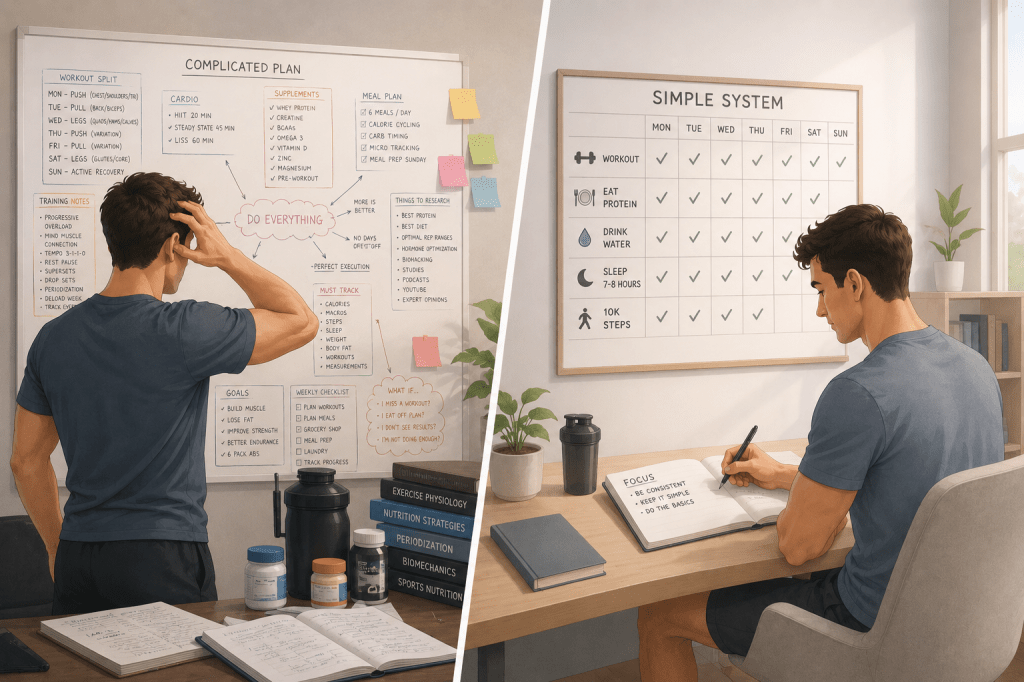
Some people seem to just be consistent. They train regularly, eat well, sleep on time, and show up without apparent struggle. The conclusion most people draw is that these people are built differently. More disciplined. More motivated. More mentally tough.
That conclusion is mostly wrong.
Consistency is rarely personality. It is usually structure. And the gap between someone who shows up reliably and someone who doesn’t is less about character than it is about the systems each person is operating inside.
The Misconception
The assumption runs deep. Consistent people have what it takes. Inconsistent people lack discipline. If you keep falling off your routine, the problem is something internal, a weakness in willpower or a deficit in motivation that needs to be corrected before real progress can happen.
This framing makes inconsistency a character flaw. Which means the solution is to try harder, want it more, or summon a version of yourself that simply does not give up.
That approach rarely works, and it is not because the person is too weak to execute it. It is because the diagnosis is wrong.
Why the Belief Feels Convincing
Consistent people look disciplined from the outside. You see the results, the routine, the apparent ease with which they maintain behaviors over time. Social media reinforces this. What gets shown is the outcome, the training streak, the physique, the early morning session. What does not get shown is the environment, the simplified routine, the reduced friction, the years of repetition that made the behavior feel automatic.
Motivation also feels powerful in the short term. The early weeks of a new plan carry genuine energy. Effort feels easy. Consistency feels natural. So the assumption forms: this is what it feels like when it is working. If I can maintain this feeling, I will maintain the behavior.
But the feeling does not hold. And when it fades, the behavior often follows.
What Actually Drives Consistent Behavior
Behavior is shaped less by personality than by environment. The friction involved in a task, how accessible it is, how well it fits into an existing routine, and whether it is tied to a reliable cue all determine how likely that behavior is to repeat.
A person who keeps their training shoes by the door, trains at the same time each day, and has a simple repeatable session structure is not more disciplined than someone who has to search for their gear, negotiate the time each morning, and decide what to do once they arrive. They have removed the decisions that create resistance. The behavior continues not because motivation is high, but because the path of least resistance leads directly to it.
This is what most people underestimate. The environment is not neutral. It is either working for the behavior or against it. Changing the environment changes the probability of the behavior, independent of willpower.
Why Motivation Is the Wrong Foundation
Motivation fluctuates with mood, sleep quality, stress, energy, and dozens of other variables that have nothing to do with how much someone wants to succeed. A plan built on motivation as its primary fuel will produce inconsistent execution, because the fuel supply is inherently unstable.
This is not a personal failure. It is just how motivation works. It is useful for initiating behavior. It is unreliable for sustaining it across weeks and months where conditions vary, progress slows, and life applies pressure.
Systems do not depend on how you feel on a given day. A consistent sleep schedule holds on stressful days. A simple meal structure holds when motivation is low. A training routine with low barrier to entry holds when energy is average. These behaviors continue not because the person is especially driven that day, but because the system is designed to run without requiring peak motivation.
How Repetition Changes the Equation
Repeated behavior becomes progressively less effortful. Actions that initially require deliberate decision-making become habitual, eventually running with minimal conscious involvement. That is not a metaphor. It reflects real changes in how the brain processes familiar sequences of behavior.
The implication is practical. The goal of building consistency is not to maintain high motivation indefinitely. It is to reduce the number of active decisions required to execute the behavior, until showing up becomes the default rather than the exception.
That process takes time and repetition. It cannot be shortcut by trying harder. But it can be accelerated by reducing friction, anchoring behaviors to reliable cues, and keeping the routine simple enough to execute on difficult days, not just easy ones.
What Coaching Shows
Clients who simplify their routines stay consistent longer than those who build elaborate plans. A person training three days per week on a fixed schedule, with sessions they can complete in 45 minutes, will accumulate more productive training over six months than someone with an optimized five-day program they execute inconsistently.
Highly motivated starts are among the most reliable predictors of early dropout. The intensity of early commitment often produces a routine that cannot hold once motivation normalizes. When the inevitable dip comes, the gap between the plan and current capacity is too large to bridge, and the whole thing stops.
People also fail more frequently from unrealistic expectations than from genuine lack of effort. When one missed session feels like evidence of personal failure, the emotional cost of imperfection becomes a reason to disengage entirely. Removing that interpretation, treating a missed day as data rather than a verdict, changes what happens next.
The problem is rarely the person. It is usually the environment they are operating in and the expectations they are holding themselves to.
What Needs to Stop
Stop waiting to feel motivated before starting. Motivation follows action more reliably than it precedes it. Stop treating discipline as a reserve that can be drawn on indefinitely. It depletes, particularly under stress and poor sleep. Stop building routines that only work when everything is going well. They will fail the first time conditions shift. Stop treating missed days as evidence of a deeper problem. They are part of any realistic long-term process.
What to Build Instead
Lower the friction on the behaviors that matter. Make them easier to start, not more impressive to complete. Build routines that are repeatable under average conditions, not ideal ones. Plan around real life constraints rather than an imagined version of the week.
Track consistency rather than perfection. A record of showing up most of the time across months is more valuable than a perfect streak that collapses. Make the environment support the behavior rather than relying on willpower to overcome the environment each time.
Small, repeatable actions compound. Elaborate, motivation-dependent plans do not.
The Shift That Holds
From needing more discipline to building better systems.
From asking how to stay more motivated to asking what needs to be simplified, removed, or restructured so the behavior can continue when motivation is ordinary.
Consistency is not something you are born with. It is something you construct, deliberately, through the routines you build and the environment you design.
The people who maintain it long term are rarely the most driven. They are the most repeatable. And repeatability is not a personality type. It is a skill that can be built by almost anyone willing to stop relying on how they feel and start focusing on how their system is designed.
Leave a comment
-
Start. Follow. Slip. Quit. Repeat.

You have been here before.
You pick a plan, commit to it, follow it reasonably well for a while, and then something small goes sideways. A stressful week. A dinner you didn’t plan for. A few days where everything felt harder than it should. And then, somehow, you are off track again.
The frustrating part is not just that it happened. It is that it keeps happening. Same arc, slightly different circumstances. You start with genuine intent, make real progress for a stretch, and then find yourself back at the beginning wondering what went wrong this time.
If this sounds familiar, you are not alone. And the reason it keeps repeating probably has less to do with what you think.What It Feels Like From the Inside
When the cycle breaks, the explanation usually comes quickly.
You lost momentum. You weren’t disciplined enough. You got comfortable. You just didn’t want it badly enough this time.
It feels like a reasonable explanation because there is something visible to point to. You had a plan. You stopped following it. So the gap between those two things must come down to effort.
Most people land here, and it is not hard to understand why. The logic is clean. You see what you intended to do and what you actually did, and the simplest way to explain the distance between them is motivation. So the next attempt begins with that framing in mind. This time I will be more committed. This time I will not let a bad day derail me. This time I will push through.
And for a while, that works. The early weeks feel different. You feel in control, engaged, clear on what you are doing. The plan is working.
Then something shifts.The Gap in That Explanation
Here is where it is worth slowing down.
If motivation were truly the problem, the pattern would not repeat so reliably. A person with a genuine motivation problem would struggle to start at all, or would fall off within days. But that is not usually what happens. Most people follow the plan well for a period. They are consistent, they see results, they feel capable.
Then something changes. Not their knowledge of the plan. Not their understanding of what they need to do. Something else. And that something else tends to show up in moments that don’t look significant from the outside.
A particularly stressful afternoon. A social situation that throws off the routine. An evening where everything feels harder than expected. A small unplanned meal that, for reasons that are difficult to articulate, feels like more than just a meal.
These moments are where most plans quietly begin to unravel. Not in one dramatic decision, but in a series of small ones that seem disconnected until you look at the pattern across many attempts.What Food Starts to Mean
Food is rarely just food. That sounds like something you might read on a wellness blog and skip past, but it is worth sitting with for a moment.
Over time, eating accumulates meaning. It becomes the thing you look forward to after a long day when there is not much else to look forward to. It becomes comfort when you are anxious and distraction when you are bored. It becomes a reward when you have done well, and sometimes a form of relief when you haven’t. It is woven into social occasions, into routines, into the small rituals that make up daily life.
None of this is unusual. Most people have some version of this relationship with food. The problem is not that it exists. The problem is that most diet plans are built as if it doesn’t.
A meal plan tells you what to eat and how much. It does not tell you what to do when you are sitting alone at nine in the evening feeling low and the fridge is right there. It does not account for the fact that after a particularly hard conversation at work, the idea of tracking your dinner feels almost offensive. It does not address what happens in your head in the five minutes after you eat something you didn’t plan to.
That is where the emotional layer enters. And it is a layer that most structured approaches to food simply do not reach.
You might eat in a way that has nothing to do with hunger, and not fully notice it until afterward. You might stop eating before you are full because you feel like you should, not because your body is asking you to. You might swing between being tightly controlled for several days and then completely releasing that control, not as a choice but as a kind of exhausted giving up.
These patterns are not character flaws. They are learned responses, built over years, and they run underneath whatever plan you happen to be following at the time.Why the Methods Don’t Quite Get There
Tracking calories works. Eating cleaner works. Intermittent fasting works. Structured meal plans work. These are not bad tools. Each one addresses something real.
Tracking improves awareness of how much you are eating. Clean eating improves the quality of what goes in. Meal plans add structure and reduce daily decision fatigue. Fasting narrows the window in which eating decisions have to be made.
All of these solve part of the problem.
What they generally do not address is what happens when things go off plan. They do not have a mechanism for the moment when you have eaten more than intended and are now deciding how to respond to that. They do not help with the discomfort of a stressful day that makes the whole system feel irrelevant. They work well when conditions are stable and you have the capacity to follow through. When those conditions shift, the same emotional patterns that were always there are still there, just without a plan that accounts for them.
So the method holds for a while. Then real life applies enough pressure, and the same old responses come back.The Cycle in Detail
The breakdown rarely announces itself.
It usually begins with something small. You eat something off plan. You miss a workout. You have a day where everything felt like too much and eating was the one thing that offered relief. In isolation, none of these are serious. They are just days.
But then something else happens. The small slip starts to carry weight.
You delay logging the meal because you do not want to see the number. You skip a check-in because things did not go well and it feels too uncomfortable to report that. You tell yourself you will get back on track tomorrow, and tomorrow becomes a few days, and a few days becomes a week.
At some point, restarting from scratch starts to feel cleaner than continuing with something that already feels compromised. So you look for a new plan. A different structure. Sometimes a different coach. Not because the last approach was fundamentally wrong, but because starting fresh feels like it comes with a reset of all the weight that accumulated around the previous attempt.
This is a very human response. It is also what keeps the cycle going.
There is also a quieter version of this that is worth naming. When things are not going well, many people pull back from accountability. They stop checking in. They go quiet. Not because they do not care, but because the discomfort of admitting the struggle out loud feels worse than just dealing with it privately. The shame of having slipped, even slightly, can feel larger than the slip itself.
And so the avoidance becomes its own problem. The longer someone stays out of the process, the harder re-entry feels.When the Goal Becomes a Way to Avoid Looking
There is a layer to this that takes a while to see, and it is worth approaching carefully because it can sound like criticism when it is not meant to be.
Having a weight loss goal gives you something concrete to focus on. A number to work toward. A plan to follow. A set of behaviors to improve. That structure is genuinely useful. It gives direction when things feel unclear.
But sometimes, the goal also becomes a way of staying busy on the surface of the problem while not having to look at what is underneath it.
As long as the focus stays on finding the right plan, fixing the last attempt, or preparing for the next restart, there is always something practical to do. Something to research, refine, adjust. And that activity, however well-intentioned, can function as a kind of distance from the more uncomfortable question: what is actually happening in the moments when things fall apart?
This is not something people do deliberately. Most people are not consciously avoiding anything. But if the cycle keeps repeating across different plans, different structures, and different levels of motivation, it is worth asking whether the plan is actually the variable that needs changing.The Piece That Usually Goes Unaddressed
Most systems are built around control. What to eat, how much, when. They are designed to manage inputs. They are not designed to address what happens when control slips.
What do you do in the ten minutes after eating something you didn’t plan to? Do you write off the rest of the day? Do you try to compensate by eating less later? Do you feel a kind of internal collapse, where the energy that was holding everything together just goes quiet?
How quickly can you return to your normal routine after a bad meal, a bad day, a bad week, without needing to formally restart?
These questions matter more than most people realize. Not because perfect consistency is the goal, but because progress over time is not built on the good days. It is built on how quickly and quietly you return after the difficult ones.
If every small slip becomes a full reset, the cycle will keep repeating regardless of the quality of the plan you are following.A More Useful Starting Point
Instead of asking what the best approach is, it is worth asking a different question: what usually happens when things go off track?
Not to judge the answer. Just to observe it honestly.
Do you stop engaging with the process entirely? Do you eat more because you already feel like the day is lost? Do you avoid contact with anyone who might hold you accountable because the discomfort of being seen in that moment feels too large?
These patterns are not random. They are consistent, and because they are consistent, they are also workable. Once you can see the pattern clearly, you can begin to respond to it differently. Not by eliminating it, but by shortening the gap between going off track and returning.
That is the actual skill. Not perfect adherence, but faster, lower-drama recovery.What This Is Really About
Fat loss still comes down to consistency and overall intake. That part does not change.
But for a lot of people, the obstacle is not understanding what to do. The obstacle is staying in the process when things are not going cleanly. When the day is hard, when the plan breaks, when the feeling underneath the eating is something that a calorie target cannot speak to.
The plans that hold are not the most optimized ones. They are the ones built with enough flexibility to absorb real life, and paired with enough self-awareness to recognize what is actually happening when things get difficult.
You do not need a better plan. You need a more honest understanding of your own pattern.
That is a less satisfying answer, because it does not come with a new structure to follow. But it is the one that actually changes the cycle.Leave a comment
-
Why Sleep Is the Most Underrated Fat Loss Tool

The standard fat loss equation is straightforward. Eat less, move more, stay consistent. That framing is not wrong. It is just incomplete.
You can follow a well-structured diet. You can train four or five times a week with genuine effort. You can track your food with reasonable accuracy. And still, progress can stall, hunger can feel unmanageable, and the results you expect from that level of effort simply do not show up.
In many of those cases, the missing variable is not the diet. It is not the training program. It is the one thing most people are quietly sacrificing while trying to do everything else right.
Sleep is not a passive recovery tool sitting at the edge of your fat loss plan. It is one of the central mechanisms through which that plan either works or doesn’t.
Why Sleep Gets Treated as Optional
The misconception is understandable.
Diet is visible and measurable. You can track what you eat, see the numbers, and make adjustments. Training is active and produces immediate feedback. You can feel the effort, log the sessions, and observe the changes in performance over time. Both feel productive because they require deliberate action.
Sleep feels like the opposite. It is passive. It happens when you are not conscious. You cannot optimise it the way you optimise a meal plan. It does not fit neatly into the effort-equals-progress model that most people use to think about fat loss.
So it gets treated as secondary. Something that would be nice to improve, but is not really driving outcomes. As long as calories are controlled and training is consistent, the assumption is that sleep can be compressed without consequence.
That assumption is incorrect.
What Happens to Appetite When Sleep Is Poor
Sleep deprivation alters the hormonal environment that regulates hunger.
Specifically, it reduces leptin, the hormone that signals satiety, and increases ghrelin, the hormone that drives appetite. The result is a physiological state that makes you hungrier than you would otherwise be, while simultaneously reducing the signals that tell you when you have had enough.
This is not a matter of willpower. It is a shift in the hormonal baseline that governs eating behaviour. Research also shows that sleep-deprived individuals tend to find high-calorie, palatable foods more appealing and are more likely to eat past the point of satiety.
In practical terms, this means that poor sleep makes calorie control harder. Not because the diet is wrong or the person lacks discipline, but because the internal regulation system has been compromised. Someone managing a 400-calorie daily deficit while sleep-deprived is fighting a significantly steeper biological gradient than someone executing the same deficit well-rested.
The diet has not changed. The state in which it is being executed has.
How Sleep Shapes Energy, Focus, and Daily Behaviour
The effects of poor sleep extend well beyond hunger.
Sleep deprivation reduces total energy output in ways that are often invisible. Spontaneous movement, the walking, fidgeting, and general activity that accumulates across a day, tends to drop when sleep is inadequate. This reduction in non-exercise activity can meaningfully erode the daily calorie deficit without any change to formal exercise or diet.
Decision-making also deteriorates. The prefrontal cortex, which governs impulse control and long-term reasoning, is particularly sensitive to sleep loss. This is relevant to fat loss because food decisions, especially in unplanned moments, rely on exactly that capacity. The ability to pause, assess, and make a deliberate choice rather than a reactive one is degraded when sleep is poor.
You do not just feel tired. You behave differently. Your threshold for making good decisions under pressure is lower. Your tolerance for dietary discomfort is reduced. And your motivation to train, particularly for sessions that require genuine effort, is measurably diminished.
Consistency, the actual driver of long-term fat loss, becomes harder to maintain in a sleep-deprived state. Not occasionally harder. Structurally harder, day after day.
What Sleep Does to Body Composition Specifically
This is the part that tends to surprise people.
Research looking at fat loss in calorie deficits has found that sleep quality significantly influences what kind of weight is lost. In studies comparing adequate sleep to sleep restriction under equivalent calorie deficits, the sleep-restricted group lost a higher proportion of lean mass relative to fat mass.
The total weight loss may look similar on a scale. The composition of that loss is meaningfully different.
This matters because lean mass is metabolically active. Losing it reduces resting metabolic rate and compromises body composition in ways that are not visible until later. Someone who loses a significant amount of muscle during a diet will find it harder to maintain results afterwards, and will have less structural capacity for future fat loss phases.
Sleep also influences growth hormone release, which occurs primarily during deep sleep stages and plays a role in tissue repair and lean mass preservation. Consistent disruption of sleep architecture reduces this output and compromises the recovery processes that make training productive.
Same effort. Same calories. Different outcome, depending on how well you are sleeping.
How Poor Sleep Undermines Training Quality
Training is only useful if it can be recovered from.
Poor sleep reduces strength output, slows muscular recovery, and increases the perception of effort at any given intensity. Sessions that would be manageable under normal conditions feel harder, take more out of the system, and produce less adaptive stimulus relative to the fatigue they generate.
Over time, this creates a compounding problem. Training quality degrades. Recovery between sessions lengthens. The athlete or recreational gym-goer may maintain the schedule on paper, checking the sessions off, but the actual quality of that work has declined significantly.
Adding more training volume during periods of poor sleep rarely helps. The additional stimulus is not being absorbed effectively, and the extra fatigue compounds what is already present. Progress plateaus not because the program is inadequate, but because the conditions required to adapt to it no longer exist.
The Trade-Off Most People Do Not See Clearly
The common justification for sacrificing sleep is productivity. Early mornings, late nights, squeezing in training before the day starts or working after it ends. The logic is that more time spent on useful things produces more results.
Over a day or two, that trade-off is manageable. Across weeks and months, it accumulates into a state of chronic partial sleep deprivation that quietly undermines the effort being invested in everything else.
Better adherence to a diet is possible with adequate sleep. Training produces better results when recovery is sufficient. Hunger is easier to manage when hormonal regulation is intact. The discipline required to maintain a fat loss phase is significantly reduced when the biological systems supporting that behaviour are functioning properly.
Prioritising sleep is not sacrificing productivity. It is removing a variable that is actively degrading the return on every other investment being made.
What Shows Up in Coaching
Patterns across clients are consistent enough to be instructive.
Clients who sleep poorly almost always report higher hunger, more frequent cravings, and greater difficulty adhering to their nutrition targets, even when the targets themselves are reasonable and well-designed. When sleep improves, hunger often becomes noticeably more manageable without any change to the diet itself.
Fat loss plateaus frequently correspond with periods of disrupted sleep. Improving sleep quality, sometimes without adjusting anything else, has resolved plateaus that additional dietary restriction and increased training volume had failed to break. The program was adequate. The state in which it was being executed was not.
Late-night habits are a consistent point of interference. Screens, stimulation, variable bedtimes, and late eating all push against the sleep architecture required for quality recovery. These habits often damage consistency more than dietary imprecision does, but they are rarely the first thing examined when progress stalls.
There is also a subtler observation. Clients who sleep well tend to require less aggressive dieting to see results. Their adherence is higher, their hunger is more stable, their training is more productive, and the overall process is considerably less effortful. The plan does not need to be as tight because the system executing it is functioning better.
The issue is not always the plan. It is the state in which the plan is being carried out.
What Needs to Stop
Stop treating sleep as the variable that gets cut when everything else demands more time. Stop sacrificing sleep for early morning workouts under the assumption that the training benefit outweighs the recovery cost. In most cases of chronic sleep restriction, it does not.
Stop relying on discipline alone to manage hunger that is partly driven by hormonal disruption from poor sleep. That is a losing battle by design. Stop ignoring late-night routines as irrelevant to fat loss outcomes. They are not.
Stop assuming that because effort is high, results should follow automatically. Effort applied in a state of inadequate recovery produces diminished returns regardless of how well the diet and training are structured.
What to Build Instead
Establish a consistent sleep and wake schedule, including on weekends. The body’s circadian regulation responds to consistency. Irregular patterns reduce sleep quality even when total hours appear adequate.
Target seven to nine hours of sleep for most adults engaged in regular training. Less than seven hours consistently places measurable stress on the hormonal and metabolic systems that support fat loss.
Reduce late-night stimulation. Screens, bright light exposure, and high-intensity mental activity in the hour before sleep all interfere with the onset and depth of sleep. These habits are adjustable without significant lifestyle disruption.
Treat sleep as a training variable, not a lifestyle preference. Structure the training week and nutrition approach with sleep requirements factored in rather than worked around. When life circumstances temporarily reduce sleep, adjust training volume accordingly rather than maintaining intensity against a depleted system.
The Shift That Changes the Outcome
From thinking, the answer is more effort.
To understand: the answer is better recovery.
From managing fat loss through tighter control and higher output, to managing it through a system that functions well enough to make that control sustainable.
Fat loss does not happen because you force the body into change through sheer discipline. It happens when the conditions for adaptation are consistently present. Sleep is one of the primary mechanisms through which those conditions are either maintained or compromised.
It does not directly burn fat. What it does is determine whether the diet works, whether the training produces results, whether hunger stays manageable, and whether the person executing the plan can sustain it across weeks and months rather than days.
You cannot outwork poor recovery. You can only build a system that does not require you to try.
Leave a comment
-
What Fatigue Actually Is and Why You Misread It
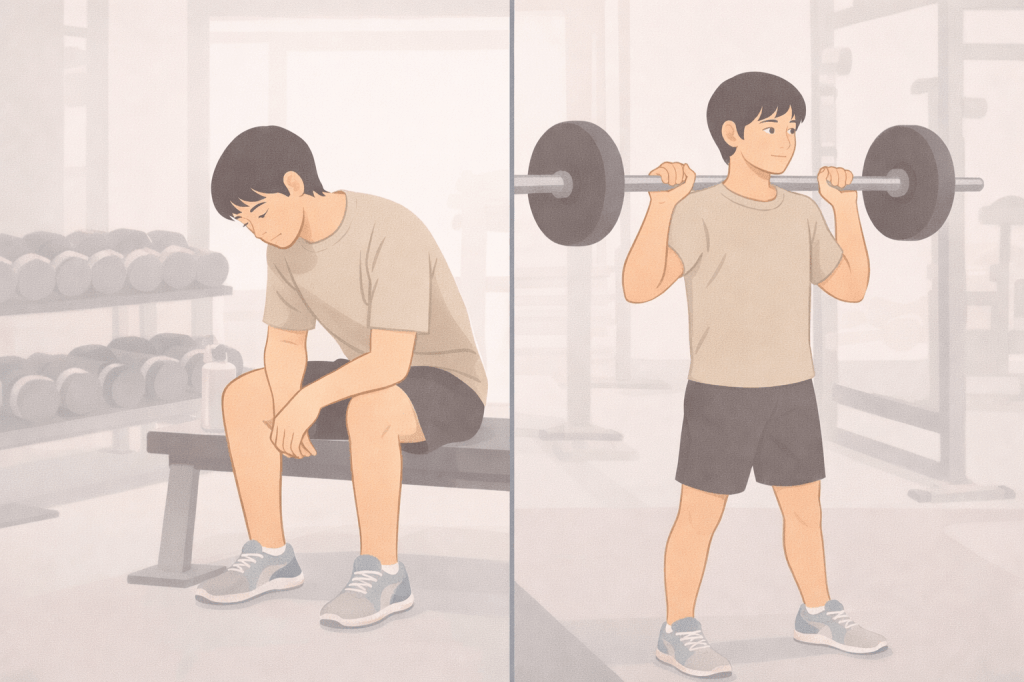
Fatigue is not a single signal. It is a message you are misinterpreting.
Most people do not struggle with fatigue. They struggle with understanding what it means. They treat it as a simple indicator, a binary switch that tells them to stop or push harder. In reality, fatigue is complex, multi-dimensional, and often misleading.
The Misconception: Fatigue as a Simple On-Off Switch
The common belief is that fatigue is a simple indicator of effort. That if you feel tired, you must be working hard or need to rest. That the feeling itself is a reliable guide for decision-making, telling you whether to push through or back off.
This leads to the assumption that fatigue equals weakness or lack of discipline. If you feel tired and stop, you are soft. If you feel tired and push through, you are strong.
Both interpretations miss the point.
Why It Sounds Logical
Fatigue feels physical and immediate. You feel heavy legs. Low energy. Reduced performance. The sensation is real, tangible, impossible to ignore.
So the conclusion becomes automatic: “I am tired, therefore I must be underperforming.” The logic is clean. The feeling is strong. The decision seems obvious.
But perception is not always aligned with physiology. What you feel is not always what is happening.
What Science Actually Shows: Fatigue Is Multi-Dimensional
Fatigue is not one thing. It includes peripheral fatigue, which is muscle-level limitation caused by metabolic byproducts, glycogen depletion, or structural damage to muscle fibers. This is the fatigue you can measure. The kind that shows up in reduced force production or slowed contraction speed.
It also includes central fatigue, which is nervous system regulation. The brain and spinal cord reduce neural drive to muscles, not because the muscles cannot contract, but because the system is protecting itself from excessive stress. This is fatigue as a governor, not a limit.
And it includes psychological fatigue, which is perception and motivation. How tired you feel based on sleep quality, stress levels, mental engagement, and emotional state. This is fatigue as interpretation, not capacity.
These do not always align. You can have high peripheral fatigue but low psychological fatigue and still perform well. You can have low peripheral fatigue but high psychological fatigue and feel incapable.
The Brain’s Role: Protection, Not Permission
The brain regulates output to protect against excessive stress. It does not wait for complete failure. It reduces effort before damage occurs. This is why you often stop before true physiological limits. The fatigue you feel is the brain saying “slow down” not “you are empty.”
Perception and capacity are not the same. You can feel exhausted and still perform well. You can feel fine and perform poorly. Fatigue is partly shaped by sleep, stress, nutrition, and training load. It is influenced by context, not just effort.
The Trade-Offs: Ignoring vs. Over-Respecting Fatigue
Ignoring fatigue can improve short-term performance. Pushing through discomfort sometimes reveals that capacity was higher than perception suggested. But it increases injury and burnout risk. Chronic disregard for fatigue signals leads to overtraining, immune suppression, and performance decline.
Over-respecting fatigue reduces training stimulus. If you back off every time you feel tired, you never stress the system enough to adapt. Progress slows. Adaptation stalls.
The trade-off is not whether to ignore or obey fatigue. It is how to interpret it. Fatigue is information, not instruction.
What Happens in Real Coaching Environments
In practice, clients often skip sessions due to perceived fatigue but perform well when they train. They feel tired before starting, then hit their numbers without issue. The fatigue was psychological, not physiological.
Others push through chronic fatigue and plateau. They ignore every signal, train through exhaustion, and wonder why progress stops. They mistake persistence for strategy.
Many confuse mental fatigue with physical limitation. A stressful day at work creates the perception of being too tired to train, even though the body is capable. The fatigue is real, but it is not muscular.
Inconsistent training often comes from misreading signals, not lack of discipline. People train when they feel good and skip when they feel bad, creating erratic stimulus and poor adaptation.
Fatigue is often misclassified, not mismanaged. The problem is not that people are tired. It is that they do not understand what kind of tired they are.
What You Should Stop Doing
Stop treating fatigue as a stop signal. Feeling tired does not automatically mean you should not train. It means you should assess why you feel tired and adjust accordingly.
Stop assuming tired means incapable. Perception of fatigue often exceeds actual depletion. You are usually more capable than you feel.
Stop relying only on how you feel. Subjective fatigue is influenced by too many variables to be the sole decision-making tool. Use objective measures where possible.
Stop making day-to-day decisions emotionally. Training decisions based on daily mood create inconsistency. Structure should guide execution, not impulse.
What You Should Focus On Instead
Track performance trends, not feelings. If your weights, reps, or speed are declining over weeks, that is meaningful fatigue. If you just feel tired but performance holds, that is perception.
Distinguish between types of fatigue. Is this muscular soreness? Mental exhaustion? Poor sleep? Each requires a different response. Muscular fatigue might need lighter load. Mental fatigue might need movement without intensity. Sleep deprivation needs sleep, not more rest days.
Use structure instead of impulse. Decide in advance when you will train and what you will do. Execute the plan unless objective data suggests otherwise. Do not renegotiate daily based on how you feel.
Adjust load, not abandon sessions. Feeling fatigued does not mean skip the workout. It might mean reduce the weight, shorten the session, or lower intensity. Showing up at 70% is better than not showing up at all.
Prioritize sleep and recovery inputs. Fatigue that accumulates from poor sleep, inadequate nutrition, or chronic stress will not improve by skipping training. It improves by addressing the root cause.
The Identity Shift: From Feeling-Based to Structure-Based
Move from “I train based on how I feel” to “I interpret signals and act with structure.” The first approach is reactive, inconsistent, and unreliable. The second is deliberate, sustainable, and effective.
Move from emotion-driven to data-informed. Feelings provide information. They do not dictate action. Performance metrics, recovery markers, and planned structure guide decisions. Emotions are acknowledged, not followed blindly.
This shift is not about ignoring your body. It is about understanding it better. It is about recognizing that fatigue is complex, that perception is not always accurate, and that the signal you are reading might not mean what you think it means.
Closing: Fatigue Is Information, Not Instruction
Fatigue is real. The sensation is legitimate. The impact is measurable. But your interpretation of it determines your outcome.
The goal is not to eliminate fatigue. Training creates fatigue. Adaptation requires it. The goal is to understand it well enough to keep moving forward. To distinguish between fatigue that signals necessary rest and fatigue that is simply perception. To know when to push and when to pull back, based on evidence rather than feeling.
Fatigue will always be present. The question is whether you let it control your decisions or inform them. Whether you react to it emotionally or respond to it strategically. Whether you see it as a limit or as feedback.
Learn to read it correctly, and it becomes a tool. Misread it, and it becomes an obstacle.
Leave a comment
-
Body Recomposition Is Slower Than You Think and That’s the Point
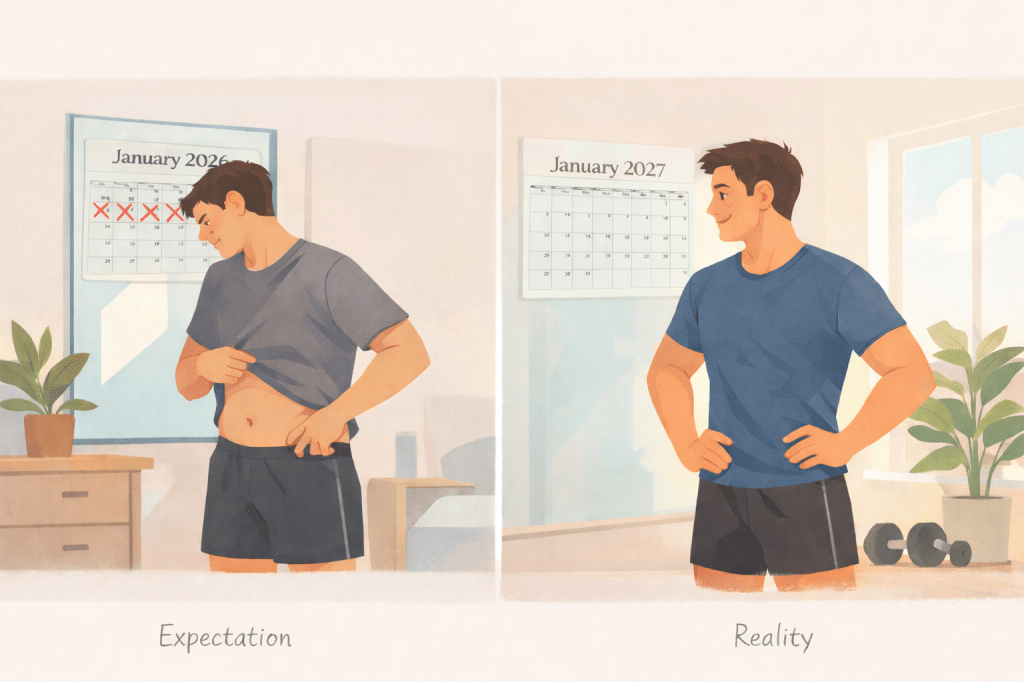
Body recomposition is possible. It is also slow by design. If it feels fast, it is usually not recomposition.
The Misconception
The common belief is that fat loss and muscle gain can happen rapidly together. That the body can aggressively burn fat while building muscle at the same time. That short-term visible changes, the kind you see in a few weeks, equal successful recomposition.
Underlying this is an assumption: more effort speeds up both processes simultaneously.
It does not.
Why It Sounds Logical
Beginners often see early changes. They lose some fat. They gain some strength. The body looks different. This creates the impression that recomposition happens quickly.
Marketing reinforces this. Programs promise to help you lose fat and gain muscle in weeks. Before-and-after photos compress months into dramatic comparisons. The message is clear: you can have both, and you can have them fast.
Scale weight fluctuations create false signals. You might lose two kilograms of fat and gain one kilogram of muscle, but the scale only shows a one-kilogram drop. You assume progress is slow when, in composition terms, it is actually significant.
Fat loss and muscle gain are often discussed together, so people assume they occur at the same rate. They do not.
What Science Actually Shows
Fat loss requires a calorie deficit. You must consume less energy than you expend. This signals the body to mobilize stored energy. Muscle gain requires sufficient energy and stimulus. You must consume enough to support tissue synthesis and provide the raw materials for growth.
Trying to maximize both at once creates competing signals. A deep deficit accelerates fat loss but limits muscle growth. A surplus supports muscle growth but slows or reverses fat loss. Recomposition sits in the narrow space between these extremes.
Recomposition is context-dependent. It occurs more effectively in beginners who have not yet adapted to training stimulus, detrained individuals returning after a break, and populations with higher body fat where energy reserves support muscle synthesis despite a deficit.
Even in these groups, rates are slow and controlled. A beginner might gain a few hundred grams of muscle per month while losing fat. That is real progress. It is also imperceptible week to week.
Muscle gain is a slow process. Even in ideal conditions, with a calorie surplus, optimal training, and adequate recovery, muscle tissue builds gradually. Progress is measured in months, not weeks. Fat loss can be faster. You can lose several kilograms of fat in a month under aggressive conditions. That mismatch creates unrealistic expectations. People expect muscle to appear as quickly as fat disappears. It does not.
The Trade-Offs
Aggressive fat loss produces faster scale change. You see results quickly. But it increases muscle loss risk, particularly if protein is inadequate or training stimulus is insufficient. Performance often declines. Strength drops. Recovery suffers.
Focused muscle gain produces better strength progress. You lift heavier. You recover faster. But fat reduction slows or stops entirely. If you are carrying excess fat, this approach may not align with your goals.
Recomposition offers a balanced approach. You lose fat slowly while gaining muscle slowly. Visual change is gradual. But the outcome is more sustainable. You build muscle you can keep while losing fat that does not return.
The trade-off is speed versus quality. Fast results often lack durability. Slow results, built with precision, tend to last.
Coaching Reality
In practice, clients chasing recomposition often lack patience. They expect visible change within weeks. When it does not appear, they assume the plan is not working. They change programs frequently, switching approaches every few weeks. This disrupts progress because adaptation requires consistency over time.
Scale obsession masks real changes. Someone might lose fat and gain muscle but see minimal scale movement. They interpret this as failure when it is actually success. Body composition improved even though weight did not drop dramatically.
Consistent moderate plans outperform aggressive ones. A small deficit, adequate protein, and progressive training sustained for months produces better outcomes than extreme deficits followed by binges or program-hopping.
Recomposition works best when it is not rushed. The slower the process, the more sustainable the result.
What to Stop Doing
Stop expecting rapid visible changes. Recomposition does not produce dramatic transformations in weeks. It produces subtle improvements over months that compound into significant change over a year.
Stop changing programs every few weeks. Adaptation takes time. Switching constantly prevents your body from responding fully to any single approach.
Stop relying only on scale weight. Weight is one metric. It does not distinguish between fat, muscle, water, or digestive content. Track measurements, progress photos, and performance.
Stop combining aggressive deficits with high expectations for muscle gain. A steep deficit prioritizes fat loss, not muscle growth. If recomposition is the goal, the deficit must be moderate.
What to Focus On Instead
Prioritize consistent training with progressive overload. Muscle growth requires increasing stimulus over time. Lift heavier, do more reps, or improve form under the same load. Progress must be measurable.
Ensure adequate protein intake. Protein supports muscle retention and growth, particularly in a deficit. Most people need more than they currently consume.
Maintain a small, controlled calorie deficit. Not aggressive. Just enough to create gradual fat loss without compromising recovery or performance. Typically 10 to 20 percent below maintenance.
Track strength and measurements. If your lifts improve and your waist shrinks, recomposition is happening regardless of what the scale says.
Extend your time horizon. Think in six-month and twelve-month blocks, not four-week sprints. Recomposition is a long game.
The Identity Shift
Move from “I want fast visible change” to “I am building a better body over time.”
Move from short-term results to long-term composition. The person chasing quick fixes will cycle through programs, diets, and frustration. The person committed to process will build something durable.
This shift is not motivational. It is strategic. Recomposition rewards those who can tolerate slow feedback. Those who can execute without needing weekly validation. Those who understand that the pace is not a flaw. It is the mechanism.
Closing
Recomposition is not inefficient. It is precise. The slow pace is not a design flaw. It is what allows the result to last.
Fat lost quickly often returns. Muscle built in a calorie surplus often comes with unwanted fat. Recomposition avoids both extremes by moving deliberately. It builds muscle you keep and loses fat that stays gone.
The body does not respond well to conflicting demands. It responds to consistency, patience, and intelligent programming. Recomposition provides all three, but only if you accept the timeline it requires.
If you cannot tolerate slow progress, choose a different approach. But if you value quality over speed, recomposition delivers. Just not this month. And that is the point.
Leave a comment
-
Why Doing More Exercises Rarely Leads to Better Results
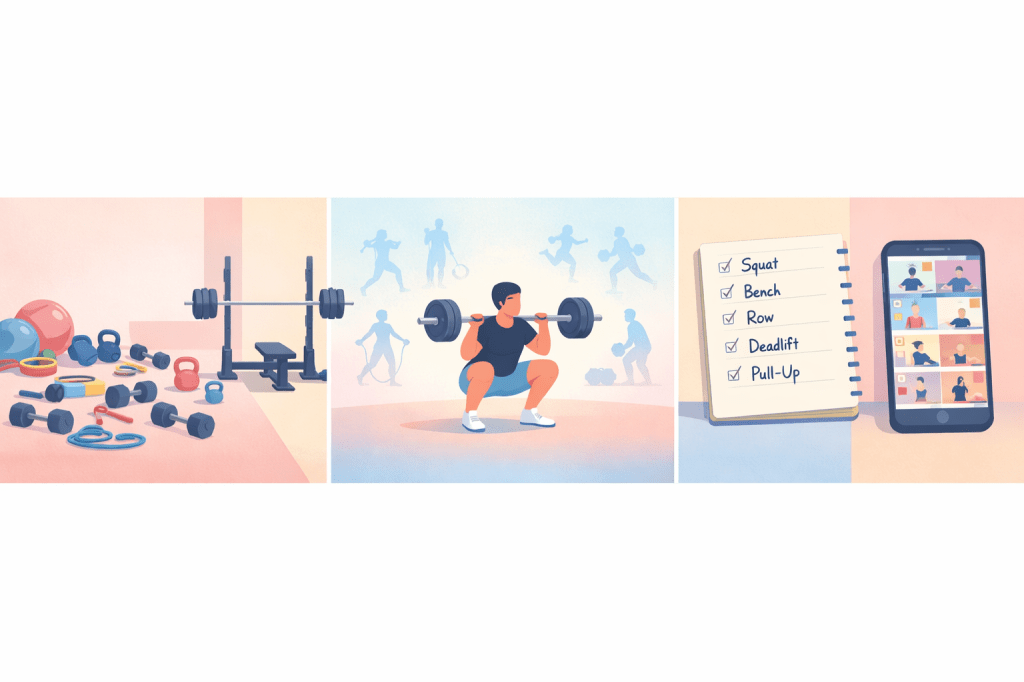
It’s a common assumption that a good workout must include a long list of exercises. Gym routines often feature twelve or more movements, each targeting a slightly different angle or muscle region. Variety is treated as a sign of a well-designed session.
But progress in training rarely comes from doing more exercises. It comes from improving performance in fewer ones.
The Misconception
The common belief is that variety automatically produces better results. The reasoning seems straightforward. More exercises should mean more stimulus. More stimulus should mean more muscle growth or faster fat loss. Changing exercises frequently is also believed to prevent plateaus.
Underneath this logic is a deeper assumption: that complexity equals effectiveness.
This idea sounds convincing for several reasons. Different exercises do stress muscles in slightly different ways. A bench press does not feel identical to a dumbbell press, even though both target similar muscle groups. Variety can make training more interesting. Doing the same thing repeatedly can feel monotonous. Social media workouts often reward novelty and creativity rather than long-term progression. A new exercise looks more impressive than doing the same lift with slightly more weight.
It becomes easy to conclude that constant change is necessary. That sticking with the same movements means you are not progressing. That if you are not rotating exercises regularly, you are missing out on potential gains.
The problem is that novelty and adaptation are not the same thing.
What Actually Drives Progress
Strength and hypertrophy depend heavily on progressive overload. For progress to occur, the body must experience a stimulus that gradually increases over time. That requires measurable improvement in performance. You add weight. You complete more repetitions. You handle the same load with better control or reduced rest periods.
This process works best when the movements remain stable enough to track. If you squat 100 kg for five reps this week, and 105 kg for five reps next week, you have clear evidence of progress. That clarity creates momentum. It tells you the program is working. It gives you a baseline to build on.
If exercises change every session, performance becomes difficult to measure. You might bench press one week, do dumbbell presses the next, and cable flies the week after. Each exercise uses different loading parameters, different stability demands, different skill requirements. There is no clear line of progression. Instead of building on previous efforts, each workout becomes a new starting point.
You are constantly adapting to new movement patterns rather than improving existing ones. That is not inherently bad for general fitness, but it is inefficient for strength or hypertrophy.
The Role of Skill Development
Skill development plays a role that many people overlook. Strength training is not only about muscles contracting. It also involves the nervous system learning how to coordinate force production. This is called motor learning.
Repeating movements improves efficiency, stability, and motor control. Your nervous system becomes better at recruiting the right muscles at the right time. You develop better proprioception, better balance, better timing. These adaptations allow you to produce more force with the same muscle mass.
This is why beginners often see rapid strength gains in the first few weeks of training, even before significant muscle growth occurs. They are not necessarily building muscle that quickly. They are learning how to use the muscle they already have more effectively.
Frequent exercise rotation interrupts this process before the skill can fully develop. Just as you start to get efficient at a movement, you switch to something else. You spend all your time in the early, inefficient phase of motor learning and never reach the proficient phase where real loading can occur.
Volume Distribution Matters
Training volume, the total amount of work performed, contributes to hypertrophy. But how that volume is distributed matters.
When effort is spread across too many exercises, each movement receives only a small portion of meaningful stimulus. You might do three sets of bench press, three sets of incline press, three sets of dumbbell flies, and three sets of cable crossovers. That is twelve total sets for the chest, but only three sets per exercise.
Compare that to doing twelve sets of bench press across the week, with variation in rep ranges and intensity. The total volume is the same, but the stimulus is concentrated. You are building skill, strength, and coordination in one movement while still accumulating sufficient volume for hypertrophy.
Instead of driving adaptation in a few lifts, the workload becomes diluted across many. You are doing a lot, but not enough of any one thing to produce meaningful change.
When Variety Actually Helps
Variety does have a place in good programming. It is not inherently bad. The issue is how and when it is applied.
Variety can reduce boredom. If you genuinely hate doing the same thing repeatedly, some rotation can improve adherence. A program you follow inconsistently is worse than a slightly less optimal program you follow consistently.
Variety can help manage overuse stress. If a particular movement causes joint discomfort when performed frequently, rotating in a similar but slightly different exercise can provide relief while maintaining stimulus.
Variety can address weak links. If your squat is limited by hip strength, adding specific accessory work for the hips makes sense. If your bench press stalls because of tricep weakness, adding direct tricep work is useful.
The problem is not variety itself. The problem is constant novelty. The problem is changing exercises before any real adaptation occurs. The problem is treating every session like it needs to introduce something new.
Purposeful variation supports progression. Random rotation often disrupts it.
What This Looks Like in Practice
In real coaching environments, this pattern becomes obvious. Clients who progress consistently tend to repeat core lifts for long periods. Their programs revolve around a small number of movements that appear week after week. Squats, deadlifts, presses, rows. The same exercises, session after session, month after month.
Loading increases gradually. Volume is structured across the week. Accessories change occasionally, but the foundation remains stable.
Programs built around endless exercise rotation rarely produce the same steady improvement. People feel busy. They feel like they are working hard. They accumulate fatigue and soreness. But when you ask them what they can do now that they could not do three months ago, the answer is often unclear.
They cannot tell you if they are stronger because they are never doing the same lift long enough to measure strength. They cannot tell you if they have built muscle because there is no consistent performance metric to track.
Most people do not plateau because they repeat exercises. They plateau because they never improve them. They chase novelty instead of progression. They confuse stimulation with adaptation.
What to Stop Doing
Stop chasing novelty every session. You do not need a new exercise every time you train. You do not need to constantly rotate movements to keep your body guessing. Your body does not need to be confused. It needs to be progressively challenged in a way you can measure.
Stop assuming soreness means progress. Soreness indicates an unfamiliar stimulus, not an effective stimulus. If you change exercises constantly, you will always be sore because you are always doing something your body is not adapted to. But soreness is not the goal. Adaptation is.
Stop rotating exercises before meaningful adaptation occurs. Give a movement at least six to eight weeks before deciding it is not working. Long enough to improve skill, build strength, and see whether you are actually progressing.
Stop building workouts primarily for entertainment. Training does not need to be exciting. It needs to be effective. If you are constantly seeking novelty to stay engaged, you are training for the wrong reasons.
What to Focus On Instead
Focus on a small number of compound movements performed consistently. Squat, deadlift, bench press, overhead press, rows, pull-ups. Not all of them every session, but rotated intelligently across the week. These movements provide the most return on investment because they involve multiple joints, multiple muscle groups, and allow for significant loading.
Track performance across weeks. Write down what you lift. How many reps. At what weight. Compare this week to last week. Compare this month to last month. If the numbers are not improving, your program is not working, regardless of how it feels.
Maintain a stable weekly structure. Monday might be squat-focused. Wednesday might be bench-focused. Friday might be deadlift-focused. The structure repeats. The lifts repeat. What changes is the load, the volume, and the intensity.
Introduce variation strategically rather than constantly. Add a new exercise when there is a clear reason. To address a weakness. To reduce joint stress. To provide novelty after months of the same routine. But not just because you are bored or because you saw something new online.
Progress becomes easier to measure when the foundation stays the same. You know where you started. You know where you are now. You can see the trajectory clearly.
The Identity Shift
This requires a shift in identity. From someone who collects workouts to someone who builds performance.
The person who collects workouts is always searching. Always looking for the next program, the next exercise, the next variation. They accumulate information but rarely apply it long enough to see results. They confuse activity with progress.
The person who builds performance picks a direction and stays with it. They commit to a program. They execute it consistently. They track progress. They make small, deliberate adjustments based on results, not feelings. They understand that repetition is not a flaw. It is a feature.
Effective programs often look simple on paper. The same lifts appear again and again. Squat, bench, deadlift. Week after week. Month after month.
What changes is not the exercise list. What changes is that the athlete gets better at them. The weight increases. The reps increase. The form improves. The efficiency improves.
That is progression. Not novelty. Not complexity. Not variety for its own sake. Just measurable improvement in fundamental movements, sustained over time.
That is what builds strength. That is what builds muscle. That is what produces results that last.
Leave a comment
-
Carbs Are Not the Enemy. Energy Mismanagement Is.
“Carbs make you fat.”
It sounds decisive. It feels scientific. It gives you something clear to remove.
It is also incomplete.
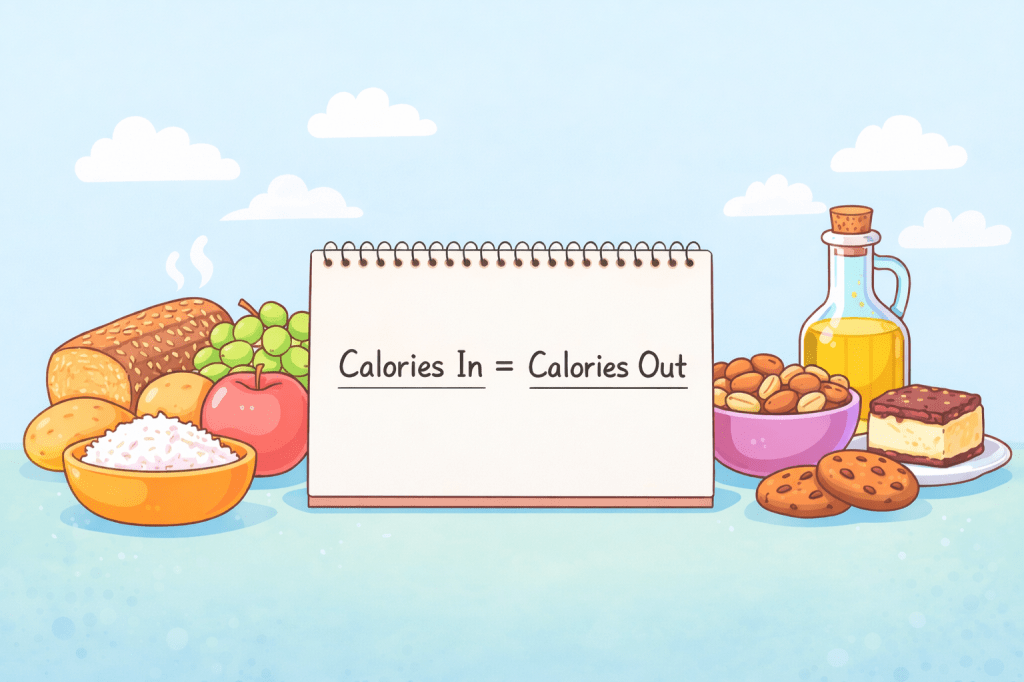
Carbohydrates do not cause fat gain. Chronic energy surplus does.
Carbs became the villain because they are visible, measurable, and easy to blame. Bread is obvious. Rice is obvious. Sugar is obvious. Total energy balance is not. You can point to a plate of pasta and identify the problem. You cannot point to the accumulated energy imbalance of an entire week with the same clarity.
So carbs became the scapegoat. And an entire industry built itself around that narrative.
Why the Belief Feels Logical
The argument usually goes like this:
Carbs raise blood glucose. Insulin rises in response. Insulin reduces fat breakdown. Therefore, carbs cause fat storage.
On the surface, that chain is clean. It has a beginning, a middle, and an end. It feels like cause and effect. It gives you a mechanism. And mechanisms feel scientific.
But short-term fat storage is not the same as long-term fat gain.
Insulin does temporarily reduce fat breakdown. That is normal physiology. It is the body’s way of prioritising the incoming nutrients rather than mobilising stored energy at the same time. Insulin also allows muscles to store glycogen and use nutrients efficiently. It directs amino acids into muscle tissue. It supports recovery.
Over a full day, what matters is not whether fat storage occurs at a single meal. It is whether total energy intake consistently exceeds energy expenditure. Because if you store fat after a carbohydrate-rich meal but burn it off later when insulin drops, net fat balance remains unchanged.
The body is dynamic, not frozen in one hormonal snapshot.
Simple cause-and-effect thinking is appealing because it removes complexity. It gives you one variable to control. One thing to fear. One thing to eliminate. But fat gain is governed by accumulated energy imbalance, not one hormone spike.
What Actually Governs Fat Gain
Fat gain occurs when energy intake chronically exceeds energy expenditure. That is the fundamental mechanism. Everything else, insulin, meal timing, and macronutrient composition, is secondary.
Carbs can contribute to energy surplus. So can fats. So can excess protein, though protein is harder to overconsume due to its satiating effects and higher thermic effect.
In controlled feeding conditions where calories and protein are matched, higher-carb diets do not automatically produce more fat gain than lower-carb diets. Studies comparing low-carb and low-fat diets with equal calories show similar fat loss outcomes. Insulin regulates nutrient flow. It does not override energy balance.
This does not make carbs magical. It makes them neutral. They are a macronutrient. A source of energy. A tool. Not inherently fattening. Not inherently slimming. Just fuel.
Carbs and Performance
Carbohydrates are stored as glycogen in muscle and liver tissue. Glycogen fuels high-intensity training. Sprinting, lifting, interval work, and anything that demands rapid energy production rely heavily on glycogen.
Adequate carbohydrate intake supports training quality, volume, and recovery. When glycogen stores are full, you can train harder, recover faster, and sustain higher outputs over time.
When carbs are aggressively reduced, performance often drops. Training intensity declines because glycogen stores are insufficient to fuel hard efforts. Total work decreases because you fatigue faster. Over time, body composition progress may stall, not because you are eating carbs, but because your training stimulus has declined due to inadequate fuel.
For athletes and serious trainees, carbs are not an optional decoration. They are functional fuel. Cutting them to chase fat loss often backfires because the training quality that drives body composition improvement deteriorates.
Why Low-Carb Diets Sometimes Work
Lower-carb approaches can be effective. This is not a defense of high-carb diets as universally superior. Context matters.
Low-carb diets work for some people because they reduce food choices. Fewer options mean fewer decisions. Fewer decisions mean less opportunity to overconsume.
They increase satiety for some people. Protein and fat are more satiating than refined carbohydrates for many individuals. A meal of eggs and avocado may keep you full longer than a bowl of cereal, even if calories are similar.
They simplify decision-making. Cutting carbs creates a clear rule. No bread. No pasta. No rice. Rules are easier to follow than nuanced energy management.
The result is often lower total energy intake. Not because carbs were fattening, but because removing them created structure that led to better energy control.
The mechanism is not carb removal itself. It is improved energy control through the structure.
That distinction matters. Because if you do not understand why low-carb works, you cannot troubleshoot when it stops working. And it will stop working if you compensate by overeating fats and proteins, which many people do.
Trade-Offs, Not Morality
Higher-carb diets often support better performance and recovery. They may be easier to sustain for active individuals who enjoy training hard and want the fuel to support it. They allow for more food variety and social flexibility.
Lower-carb diets may help certain people manage appetite and adherence. They may indirectly reduce calories by limiting food choices. They may improve metabolic markers for individuals with insulin resistance or type 2 diabetes.
Neither approach is morally superior. Carbs are not virtuous. Low-carb is not virtuous. The question is context, lifestyle, and training demands.
If you are sedentary, insulin-resistant, and struggle with hunger on higher-carb diets, lower carbs may serve you well. If you are training five days a week at high intensity and find that low-carb leaves you exhausted and weak, higher carbs make sense.
The best diet is the one you can follow consistently while supporting your goals. Not the one that aligns with an ideology.
Coaching Reality
In practice, people who blame carbs often under-report total intake. They focus on the obvious carbs, bread, rice, pasta, while ignoring the oils used in cooking, the snacks consumed mindlessly, and the weekend meals that quietly push calories above maintenance.
They cut carbs and lose weight initially. Then fat loss stalls despite continued low-carb intake. They assume their metabolism is broken or that they need to go even lower. The reality is often that total energy remains high. The carbs were replaced with fats or larger portions of protein. Energy balance did not shift enough to sustain fat loss.
On the other side, athletes restrict carbs unnecessarily and wonder why performance and recovery suffer. They blame age, stress, or poor programming. They do not realise that their bodies simply do not have the fuel to support the training demands they are placing on them.
Energy mismanagement hides behind carb elimination. People think they are solving a macronutrient problem when they are actually avoiding an energy problem.
What to Stop Doing
Stop fearing single macronutrients. Carbs are not poison. Fat is not poison. No single food or macronutrient causes fat gain in isolation. Energy imbalance does.
Stop equating insulin spikes with inevitable fat gain. Insulin is not the enemy. It is a regulatory hormone. It does its job. If you are in energy balance or deficit, insulin spikes do not cause fat accumulation.
Stop cutting carbs while ignoring total intake. You cannot eat unlimited fats and proteins and expect fat loss just because you removed carbs. Energy still matters.
Stop wearing low-carb as a badge of discipline. Dietary choices are tools, not moral statements. You are not more disciplined for avoiding carbs. You are following a strategy that may or may not serve your goals.
What to Focus On Instead
Focus on total energy intake over time. This is the variable that governs body composition. Track it. Manage it. Adjust it based on progress.
Ensure adequate protein. Protein supports muscle retention, satiety, and recovery. It is the one macronutrient that should be prioritised regardless of whether you eat high-carb or low-carb.
Train with intent and quality. Your training creates the stimulus for body composition change. Fuel it appropriately. Do not sabotage training quality by under-fueling in the name of cutting carbs.
Eat enough fibre and whole foods. Regardless of macronutrient split, prioritise nutrient density. Vegetables, fruits, and whole grains, if you eat carbs, quality fats, and lean protein,s should form the foundation.
Match carbohydrate intake to activity level. If you train hard, eat more carbs. If you are sedentary, eat less. This is not complicated. Fuel matches demand.
Choose an approach you can sustain without obsession. If low-carb feels restrictive and makes you miserable, do not force it. If high-carb makes you feel sluggish and constantly hungry, adjust. The best approach is the one you can follow long-term without constant mental negotiation.
Body composition is not determined by one nutrient. It is determined by repeated energy decisions. Hundreds of meals over months and years. Not one macronutrient choice.
The Identity Shift
Move from “Carbs are bad” to “Energy management determines body composition.”
Move from food fear to food strategy. Stop treating macronutrients as moral categories. Start treating them as tools with specific functions.
Carbohydrates are a tool. They can be overused. They can be underused. They are not the enemy.
Mismanaged energy is.
The person who understands this can eat carbs, enjoy food, train hard, and make progress. The person who does not understand this will keep cycling through elimination diets, blaming macronutrients, and wondering why nothing works long-term.
The difference is not carbs. The difference is understanding what actually drives body composition change: energy balance, training stimulus, consistency, and time.
Carbs are just one variable in that equation. And not even the most important one.
Leave a comment
-
Why Being Fit Does Not Automatically Mean You Are Healthy

We tend to treat fitness as proof of health. If someone looks lean, trains hard, runs fast, or lifts heavy, we assume their body is thriving. The assumption feels intuitive. Performance is visible. Health is not.
That shortcut is convenient, but it is also misleading.
You can be fit and unhealthy at the same time. You can run a marathon while being chronically inflamed. You can have visible abs while your hormones are dysregulated. You can set personal records in the gym while your nervous system is quietly burning out.
The disconnect between fitness and health is one of the most misunderstood concepts in modern training culture. And the confusion is not just semantic. It has real consequences for how people train, recover, and think about their bodies.
The Core Misconception
The most common mistake is treating fitness and health as interchangeable. They are not the same system. They do not measure the same things. They do not even serve the same purpose.
Fitness is the ability to perform a task. It is specific, trainable, and measurable. How fast can you run? How much can you lift? How long can you sustain effort? These are fitness questions. They have clear answers.
Health is the capacity to sustain life, adapt to stress, and recover over time. It is broader, more complex, and harder to quantify. Can your body handle disruption without collapsing? Do your systems maintain balance under pressure? Can you recover from illness, injury, or stress without lingering dysfunction? These are health questions. The answers are rarely simple.
Fitness answers the question: What can you do right now?
Health answers a different one: What can you keep doing without breaking down?
The distinction matters because optimising for one does not guarantee the other. In fact, optimising too aggressively for fitness can actively erode health if the process ignores recovery, energy availability, sleep, and stress management.
Confusing the two leads people to optimise the wrong variables. They chase performance markers while their underlying systems quietly deteriorate. They celebrate outputs while ignoring inputs. They mistake the ability to push hard for the capacity to sustain that effort over time.
Why This Belief Persists
People believe fitness equals health because performance and aesthetics are easy to measure. You can time a run, count reps, track weight lifted, or see abs in the mirror. These markers feel objective and reassuring. They give you something concrete to point to, something you can post, something you can compare.
Health markers are quieter. Sleep quality, hormonal stability, immune resilience, injury recovery, and mental bandwidth do not announce themselves on social media. They reveal themselves slowly, often only when something starts to fail. You do not notice your cortisol is chronically elevated until you stop being able to sleep. You do not realise your immune system is compromised until you are sick for the third time this month. You do not see the warning signs until they become problems.
There is also a cultural bias at play. Discipline and suffering are celebrated. Rest, restraint, and sustainability are not. When someone trains relentlessly and looks impressive, we reward the output without questioning the cost. We admire the dedication, the work ethic, and the visible results. We do not ask about sleep quality, stress levels, or how they feel when they are not in the gym.
This creates a feedback loop. People pursue what gets rewarded. What gets rewarded is visible performance. So people push harder, train more, sacrifice recovery, and tell themselves they are doing the right thing because their fitness markers are improving.
Meanwhile, the systems that actually determine long-term health, the hormonal regulation, the immune function, and the nervous system resilience, are quietly eroding. And no one notices until something breaks.
What the Evidence Actually Shows
When you look beyond surface-level performance, health becomes a broader and less glamorous concept.
Health includes recovery capacity between stressors. Not just whether you can handle one hard workout, but whether you can handle five in a row and still adapt. Whether you can train hard one day, sleep well that night, and wake up ready to do it again without accumulating fatigue that never clears.
Health includes hormonal balance, not just body composition. You can be lean and have terrible hormonal function. Low testosterone in men, menstrual irregularities in women, thyroid dysfunction, and chronic cortisol elevation, these do not show up in body fat percentage. But they show up in energy levels, mood stability, libido, recovery capacity, and long-term metabolic health.
Health includes low injury risk across years, not peak weeks. Anyone can stay injury-free for a few weeks or months by pushing through pain and ignoring warning signs. Health is about staying injury-free across years and decades because your training respects your body’s limits and builds durability instead of exploiting fragility.
Health includes nervous system stability, not constant activation. If you are always in fight-or-flight mode, if you cannot relax, if your resting heart rate is elevated and your heart rate variability is low, your nervous system is not healthy. It is stuck in overdrive. That might allow you to perform in the short term, but it breaks you down over time.
Health includes the ability to absorb life stress without collapsing. If your training is so demanding that any additional stress, a work deadline, a relationship conflict, or a poor night of sleep causes everything to fall apart, you are not healthy. You are operating on the edge of dysfunction with no margin for error.
A person can be highly fit and still be inflamed, sleep-deprived, hormonally dysregulated, and mentally exhausted. None of that shows up in a personal record. None of it prevents you from posting an impressive training session. But all of it matters for long-term health.
This is not a fringe idea. Overtraining syndrome, chronic fatigue, recurrent injuries, and burnout are common in people who appear “fit” by external standards. These are not rare edge cases. They are predictable outcomes of treating fitness as the only variable that matters.
The Trade-Offs We Ignore
High fitness often coexists with poor sleep, chronic stress, low energy availability, and fragile recovery. These trade-offs are frequently normalised or even glorified. “No pain, no gain.” “Rest is for the weak.” “Sleep when you’re dead.”
These are not motivational mantras. They are rationalisations for unsustainable behaviour.
The problem is not intensity itself. Intensity is a useful training tool. The problem is intensity without margin. When your system is always pushed to its limits, you lose resilience. Small disruptions hit harder. Missed sleep matters more. Minor injuries linger. Motivation becomes brittle instead of stable.
At that point, fitness becomes something you must constantly defend rather than something that supports your life. You cannot afford to miss a workout because your body has adapted to the stress and now requires it to maintain equilibrium. You cannot take a week off without feeling anxious because your identity is tied to performance outputs. You cannot handle a disruption to your routine without everything unravelling.
That is not healthy. That is dependence.
True health creates margin. It allows for disruption without collapse. It builds systems that can absorb stress, adapt, and return to baseline without requiring perfect conditions. It does not demand that everything go right. It functions even when things go wrong.
What to Stop Doing
Stop using performance as a proxy for health. Just because you can run faster or lift heavier does not mean your body is healthier. Performance is one data point. It tells you about your ability to execute a task under specific conditions. It does not tell you about your hormonal health, immune function, nervous system resilience, or long-term capacity to sustain that performance.
Stop assuming that because training numbers are improving, the system underneath is coping well. Performance can improve even as health deteriorates. Your body will often give you what you ask for in the short term, even if it is borrowing from resources you cannot afford to lose. You can set PRs while your cortisol is chronically elevated, your sleep is terrible, and your immune system is compromised. The performance improvement does not mean you are getting healthier. It might mean you are getting better at tolerating dysfunction.
Stop treating fatigue, poor sleep, and recurring pain as the price of being “serious.” These are not badges of honour. They are warning signs. Fatigue that does not resolve with rest is not normal. Sleep that is consistently disrupted is not something to push through. Pain that keeps coming back is not something to ignore.
These habits do not signal commitment. They signal misalignment. They indicate that the demands you are placing on your body exceed your capacity to recover from them. And if you keep ignoring that signal, the body will eventually force the issue through injury, illness, or burnout.
What to Start Focusing On
If health is the goal, the metrics change. The variables you track, the outcomes you value, the questions you ask, all of it shifts.
Start paying attention to how quickly you recover, not how hard you can push. Can you train hard and feel ready to train again within a reasonable timeframe? Or do you need days to recover from a single session? Do you wake up feeling restored, or do you wake up feeling like you need more sleep, no matter how much you got?
Recovery speed is a better indicator of health than peak output. If your recovery is fast and consistent, your body is handling the stress well. If recovery is slow and unpredictable, something is off.
Start valuing consistency across months and years, not peak output. Anyone can have a great week. Health is about having many okay weeks that add up to something meaningful. It is about being able to train regularly without constantly battling fatigue, injury, or illness. It is about showing up consistently because your body can handle the load, not because you are forcing it to.
Start tracking energy levels outside the gym, not just inside it. How do you feel when you are not training? Do you have energy for work, relationships, hobbies, and life? Or is all your energy consumed by training and recovery, leaving nothing for anything else?
If your training improves your gym performance but depletes your capacity to function in the rest of your life, that is not health. That is narrow optimisation at the expense of overall well-being.
Start noticing how your body responds to stress, illness, and disruption. When you get sick, do you recover quickly, or do illnesses linger? When you get injured, does it heal in a reasonable timeframe, or do minor issues become chronic? When life gets stressful, does your body handle it, or does everything fall apart?
Resilience under disruption is a core feature of health. If your system only works under ideal conditions, it is fragile.
Health is not about maximising output. It is about maintaining capacity. It is about building a body that can do what you need it to do, not just today, but next year, and ten years from now.
The Necessary Identity Shift
This requires a more profound shift than simply changing training variables. It requires rethinking what you value and how you define success.
Move from the identity of a “high performer” to that of a “durable human.”
A high performer asks, How far can I push today? What is the maximum effort I can sustain? How much can I extract from my body right now?
A durable human asks, What can I sustain without erosion? What load can my body handle repeatedly without breaking down? How do I build capacity that lasts?
Durability is no less ambitious. It is more intelligent. It values longevity over spectacle, resilience over aesthetics, and adaptability over control. It recognises that the ability to perform once is less valuable than the ability to perform consistently. It understands that looking impressive is less important than feeling functional.
Durability does not reject intensity. It contextualises it. It uses intensity strategically, not constantly. It builds margin so that when you do push hard, your body can handle it and recover.
A durable human is not someone who avoids challenge. It is someone whose body is robust enough to meet challenges without breaking down in the process.
The Bottom Line
Fitness is a tool. Health is the system that allows you to keep using it.
Fitness measures what you can do. Health measures what you can sustain. Fitness is about performance in a moment. Health is about capacity over time.
You can have one without the other. You can be fit and unhealthy. You can be healthy and not particularly fit. Ideally, you want both. But if you have to choose, health is the foundation. Without it, fitness becomes a house built on sand.
Confusing the two is not just an intellectual error. It is how people quietly train themselves into fragility while believing they are doing everything right. They optimise for outputs while ignoring inputs. They celebrate performance while their systems deteriorate. They mistake the ability to push hard for the presence of health.
And then, one day, something breaks. An injury that does not heal. An illness that lingers. Fatigue that does not resolve. Motivation that disappears. And they realise, too late, that fitness without health is not sustainable.
So if you are training hard, chasing performance, pushing limits, ask yourself: Am I building fitness, or am I building health? Am I creating capacity, or am I depleting it? Am I getting stronger, or am I just getting better at ignoring warning signs?
Because being fit is impressive. But being healthy is what allows you to stay fit. And confusing the two is how people who look like they are thriving end up quietly falling apart.
Leave a comment
-
Motion Over Motivation: Why Progress Starts Long Before You Feel Ready

Every January, motivation gets romanticised.
People wait for the right mood. The right Monday. The clean slate. The surge of energy that finally makes change feel effortless.
And then they wait some more.
Not because they are lazy. But because they have been taught a quiet lie: that action should begin after motivation arrives.
It does not.
Motivation is emotional. Motion is mechanical. Progress is built by the second, not the first.
Motivation Feels Powerful Because It Feels Good
Motivation is seductive. It comes with clarity, confidence, and urgency. When you feel motivated, action feels obvious. Easy. Almost inevitable.
That is exactly why people trust it.
But motivation is unstable. It fluctuates with sleep, stress, validation, novelty, and mood. It rises when life feels aligned and disappears the moment friction shows up. It is a fair-weather friend, present when you least need it and absent when you need it most.
You wake up energised one morning, ready to tackle everything. Three days later, that same task feels impossible. Nothing about the task changed. Your motivation did. And if your ability to act depends entirely on that feeling, you are building on unstable ground.
If motivation were reliable, the people who talk the most would also execute the most. They do not. The ones with the most inspiring vision boards, the most detailed plans, the most articulate explanations of what they are going to do, often accomplish the least. Because talking about change feels productive. It gives you the dopamine hit of progress without the friction of actually doing anything.
Motivation feels convincing. That does not make it dependable.
The Real Mistake People Make
The problem is not that motivation is useless. The problem is that people treat motivation as a requirement.
“I will start when I feel ready.”
“I just need to get into the right headspace.”
“I know what to do, I just don’t feel like it yet.”
This sounds responsible. It sounds thoughtful. In reality, it is often avoidance with better language.
Because here is the truth: readiness is rarely a cause. It is usually a consequence.
You do not feel ready and then act. You act, and then you feel ready. The confidence comes after the doing, not before it. The belief that you can handle something emerges from the evidence that you have already handled it, even imperfectly, even badly, even once.
Waiting to feel ready is the most socially acceptable form of procrastination.
It lets you delay without feeling guilty. It frames inaction as wisdom. It gives you permission to stay stuck while believing you are being strategic. And the longer you wait, the more intimidating the task becomes, because now you are not just starting, you are starting after all this time spent not starting.
The gap between intention and action becomes a story about who you are. Someone who does not follow through. Someone who talks but does not do. Someone who needs everything to be perfect before they can begin.
And that story, more than any lack of motivation, is what keeps you from moving.
Motion Changes the Order of Things
Most people believe progress works like this:
Belief leads to motivation, motivation leads to action, and action leads to results.
In reality, it works in reverse.
Action leads to evidence, evidence leads to belief, belief leads to identity.
Motion produces feedback. Feedback builds confidence. Confidence changes identity.
You do not act because you believe. You believe because you have acted enough times to trust yourself.
This is not motivational rhetoric. This is how behaviour change actually works. You do the thing once, badly, and you learn that you survived it. You do it again, still badly, and you learn that it gets slightly easier. You do it a third time, and it starts to feel familiar. A fourth time, and you no longer need to convince yourself.
Somewhere in that repetition, the identity shifts. You stop being someone who is trying to work out and become someone who works out. You stop being someone who wants to write and become someone who writes. Not because you declared it. Because you did it enough times that the evidence became undeniable.
Motion does not require emotional permission. It requires a decision.
What Motion Actually Means (and What It Does Not)
Motion is not intensity. Motion is not grinding. Motion is not staying busy to feel productive.
Motion is defined by three constraints.
First, the action is small enough to execute on bad days. Not just good days. Not just motivated days. Bad days. The days when you are tired, distracted, overwhelmed, or discouraged. If your standard requires ideal conditions, it is not motion. It is a performance that only happens when you feel like performing.
Second, the action is repeatable without emotional hype. It does not need a playlist, a pep talk, or the perfect environment. It does not depend on you feeling inspired. It just happens, the way brushing your teeth happens, not because you are excited about it, but because it is simply what you do.
Third, the action moves in a clear direction. It is nota random activity. It is not busy work. It serves a purpose. It compounds. It builds toward something, even if that something is just proving to yourself that you can show up again.
One workout instead of a transformation. One paragraph instead of a book. One walk instead of a reinvention.
Motion works because it bypasses emotion instead of trying to overpower it.
It does not ask how you feel. It does not wait for alignment. It just moves, and in moving, it changes you.
Why Motion Creates Meaning, Not the Other Way Around
A common objection is that this approach feels mechanical. Cold. Devoid of meaning.
But meaning rarely precedes engagement. It follows it.
People do not move because life feels meaningful. Life feels meaningful because it is moving toward something.
You do not wake up one day and suddenly feel that your work matters, and then start working with purpose. You start working, even when it does not feel meaningful, and through that work, meaning emerges. You see progress. You solve problems. You contribute something. And in that contribution, significance is built.
Stillness amplifies doubt. The longer you sit with an idea without acting on it, the more reasons you find not to. The more flaws you see. The more obstacles you imagine. Motion clarifies it. Not because motion answers all the questions, but because it reduces the space for rumination.
When you are moving, you are learning. When you are still, you are guessing.
Meaning is not found in waiting. It is built through movement.
Countering the Sceptics (Without Weakening the Argument)
Let’s address the objections directly, because this idea will be challenged.
“But motivation does start action.”
Yes. Sometimes. Motivation can ignite action. It cannot be trusted to sustain it. Treating motivation as fuel instead of a bonus is where most people fail.
Motivation is useful when it shows up. But if your ability to act depends on it showing up, you are at the mercy of something you cannot control. Motion treats motivation as a pleasant surprise, not a prerequisite.
“What about burnout or depression?”
This argument collapses if motion is misunderstood as force.
Motion is not maximal output. Motion is continuity at an honest capacity. For someone burnt out, motion might mean showing up, not excelling. For someone overwhelmed, motion might mean reducing the goal, not abandoning it.
Motion respects capacity. Motivation ignores it.
Motivation demands you feel good enough to act. Motion asks only that you act within what is sustainable. It is the difference between forcing yourself to run five miles when you are exhausted and allowing yourself to walk for ten minutes. One compound. The other breaks you.
“Isn’t this just robotic living?”
Only if motion lacks direction.
Motion without direction becomes noise. Motion with direction builds momentum. This is not about removing meaning. It is about removing emotion as a gatekeeper.
You can care deeply about what you are doing and still refuse to let your feelings dictate whether you do it. In fact, the things that matter most are often the things you need to do regardless of how you feel about them in the moment.
“Can motion become avoidance too?”
Yes. And this matters.
Staying busy is not the same as moving forward. Motion must serve a direction, not distract from discomfort. Execution without reflection becomes chaos. Reflection without execution becomes stagnation.
The key is honest assessment. Are you moving toward something, or are you moving to avoid sitting with something uncomfortable? Both involve action, but only one creates progress.
The Quiet Advantage of People Who Move Anyway
People who make progress are not more motivated. They are less dependent on how they feel before acting.
They do not wait for alignment. They create it.
They understand something most people resist: emotion is not a reliable decision-making tool.
Emotions are information. They tell you something about your state, your environment, and your needs. But they are not instructions. Feeling unmotivated does not mean you should not act. It just means you feel unmotivated. The decision to act is separate.
This is not cold or detached. It is realistic. It is the recognition that feelings change faster than circumstances do, and if you wait for your feelings to stabilise before you move, you will spend most of your life waiting.
Progress does not follow feeling good. It follows doing what was decided.
The people who change are the ones who decided what mattered when they felt clear, and then honoured that decision even when clarity faded. They built systems that did not depend on inspiration. They lowered the bar for what counted as action so that even on bad days, they could still move.
And in that movement, something shifted. Not all at once. Not dramatically. But consistently. Until one day, they looked back and realised they had become someone different, not because they felt like it, but because they kept moving when they did not.
A Constraint to End On
If you need to feel motivated to begin, you are already negotiating with resistance.
Design actions so small they do not require belief. Remove emotion from the decision to start. Let motion do the psychological work that motivation never could.
Because motivation will come and go. It will rise with wins and disappear with setbacks. It will depend on a thousand variables you cannot control.
But motion? Motion is a choice. And choices can be made regardless of how you feel.
So stop waiting for the right moment. Stop waiting to feel ready. Stop waiting for motivation to carry you.
Just move. Small. Repeatable. Forward.
And let the rest follow.
Leave a comment

Structure, psychology and ruthless execution

Leave a comment