
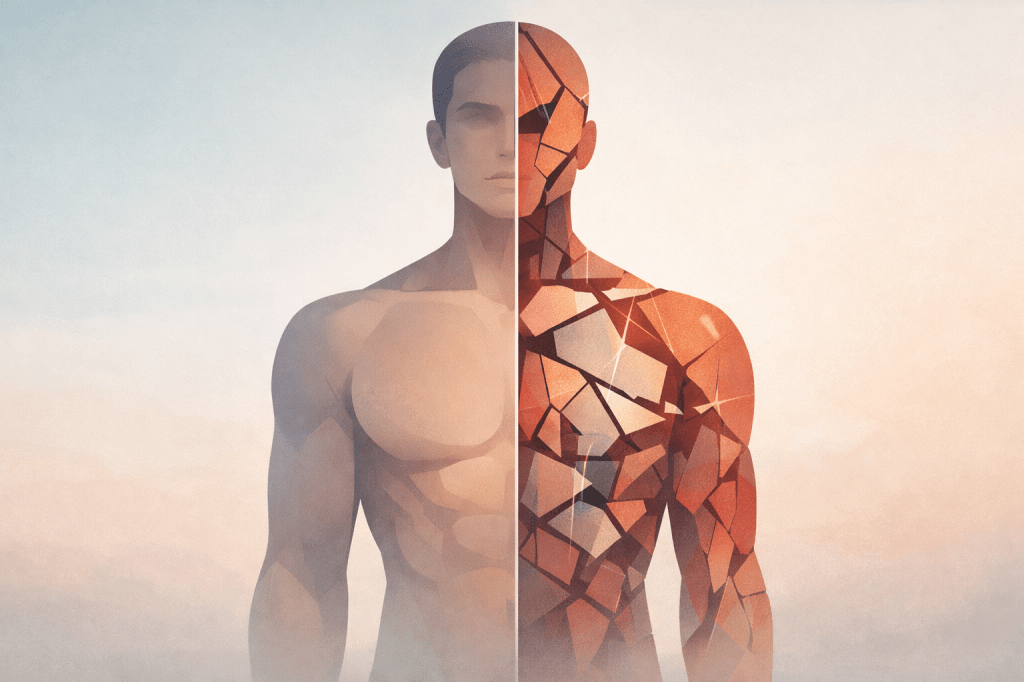
We tend to treat fitness as proof of health. If someone looks lean, trains hard, runs fast, or lifts heavy, we assume their body is thriving. The assumption feels intuitive. Performance is visible. Health is not.
That shortcut is convenient, but it is also misleading.
You can be fit and unhealthy at the same time. You can run a marathon while being chronically inflamed. You can have visible abs while your hormones are dysregulated. You can set personal records in the gym while your nervous system is quietly burning out.
The disconnect between fitness and health is one of the most misunderstood concepts in modern training culture. And the confusion is not just semantic. It has real consequences for how people train, recover, and think about their bodies.
The Core Misconception
The most common mistake is treating fitness and health as interchangeable. They are not the same system. They do not measure the same things. They do not even serve the same purpose.
Fitness is the ability to perform a task. It is specific, trainable, and measurable. How fast can you run? How much can you lift? How long can you sustain effort? These are fitness questions. They have clear answers.
Health is the capacity to sustain life, adapt to stress, and recover over time. It is broader, more complex, and harder to quantify. Can your body handle disruption without collapsing? Do your systems maintain balance under pressure? Can you recover from illness, injury, or stress without lingering dysfunction? These are health questions. The answers are rarely simple.
Fitness answers the question: What can you do right now?
Health answers a different one: What can you keep doing without breaking down?
The distinction matters because optimising for one does not guarantee the other. In fact, optimising too aggressively for fitness can actively erode health if the process ignores recovery, energy availability, sleep, and stress management.
Confusing the two leads people to optimise the wrong variables. They chase performance markers while their underlying systems quietly deteriorate. They celebrate outputs while ignoring inputs. They mistake the ability to push hard for the capacity to sustain that effort over time.
Why This Belief Persists
People believe fitness equals health because performance and aesthetics are easy to measure. You can time a run, count reps, track weight lifted, or see abs in the mirror. These markers feel objective and reassuring. They give you something concrete to point to, something you can post, something you can compare.
Health markers are quieter. Sleep quality, hormonal stability, immune resilience, injury recovery, and mental bandwidth do not announce themselves on social media. They reveal themselves slowly, often only when something starts to fail. You do not notice your cortisol is chronically elevated until you stop being able to sleep. You do not realise your immune system is compromised until you are sick for the third time this month. You do not see the warning signs until they become problems.
There is also a cultural bias at play. Discipline and suffering are celebrated. Rest, restraint, and sustainability are not. When someone trains relentlessly and looks impressive, we reward the output without questioning the cost. We admire the dedication, the work ethic, and the visible results. We do not ask about sleep quality, stress levels, or how they feel when they are not in the gym.
This creates a feedback loop. People pursue what gets rewarded. What gets rewarded is visible performance. So people push harder, train more, sacrifice recovery, and tell themselves they are doing the right thing because their fitness markers are improving.
Meanwhile, the systems that actually determine long-term health, the hormonal regulation, the immune function, and the nervous system resilience, are quietly eroding. And no one notices until something breaks.
What the Evidence Actually Shows
When you look beyond surface-level performance, health becomes a broader and less glamorous concept.
Health includes recovery capacity between stressors. Not just whether you can handle one hard workout, but whether you can handle five in a row and still adapt. Whether you can train hard one day, sleep well that night, and wake up ready to do it again without accumulating fatigue that never clears.
Health includes hormonal balance, not just body composition. You can be lean and have terrible hormonal function. Low testosterone in men, menstrual irregularities in women, thyroid dysfunction, and chronic cortisol elevation, these do not show up in body fat percentage. But they show up in energy levels, mood stability, libido, recovery capacity, and long-term metabolic health.
Health includes low injury risk across years, not peak weeks. Anyone can stay injury-free for a few weeks or months by pushing through pain and ignoring warning signs. Health is about staying injury-free across years and decades because your training respects your body’s limits and builds durability instead of exploiting fragility.
Health includes nervous system stability, not constant activation. If you are always in fight-or-flight mode, if you cannot relax, if your resting heart rate is elevated and your heart rate variability is low, your nervous system is not healthy. It is stuck in overdrive. That might allow you to perform in the short term, but it breaks you down over time.
Health includes the ability to absorb life stress without collapsing. If your training is so demanding that any additional stress, a work deadline, a relationship conflict, or a poor night of sleep causes everything to fall apart, you are not healthy. You are operating on the edge of dysfunction with no margin for error.
A person can be highly fit and still be inflamed, sleep-deprived, hormonally dysregulated, and mentally exhausted. None of that shows up in a personal record. None of it prevents you from posting an impressive training session. But all of it matters for long-term health.
This is not a fringe idea. Overtraining syndrome, chronic fatigue, recurrent injuries, and burnout are common in people who appear “fit” by external standards. These are not rare edge cases. They are predictable outcomes of treating fitness as the only variable that matters.
The Trade-Offs We Ignore
High fitness often coexists with poor sleep, chronic stress, low energy availability, and fragile recovery. These trade-offs are frequently normalised or even glorified. “No pain, no gain.” “Rest is for the weak.” “Sleep when you’re dead.”
These are not motivational mantras. They are rationalisations for unsustainable behaviour.
The problem is not intensity itself. Intensity is a useful training tool. The problem is intensity without margin. When your system is always pushed to its limits, you lose resilience. Small disruptions hit harder. Missed sleep matters more. Minor injuries linger. Motivation becomes brittle instead of stable.
At that point, fitness becomes something you must constantly defend rather than something that supports your life. You cannot afford to miss a workout because your body has adapted to the stress and now requires it to maintain equilibrium. You cannot take a week off without feeling anxious because your identity is tied to performance outputs. You cannot handle a disruption to your routine without everything unravelling.
That is not healthy. That is dependence.
True health creates margin. It allows for disruption without collapse. It builds systems that can absorb stress, adapt, and return to baseline without requiring perfect conditions. It does not demand that everything go right. It functions even when things go wrong.
What to Stop Doing
Stop using performance as a proxy for health. Just because you can run faster or lift heavier does not mean your body is healthier. Performance is one data point. It tells you about your ability to execute a task under specific conditions. It does not tell you about your hormonal health, immune function, nervous system resilience, or long-term capacity to sustain that performance.
Stop assuming that because training numbers are improving, the system underneath is coping well. Performance can improve even as health deteriorates. Your body will often give you what you ask for in the short term, even if it is borrowing from resources you cannot afford to lose. You can set PRs while your cortisol is chronically elevated, your sleep is terrible, and your immune system is compromised. The performance improvement does not mean you are getting healthier. It might mean you are getting better at tolerating dysfunction.
Stop treating fatigue, poor sleep, and recurring pain as the price of being “serious.” These are not badges of honour. They are warning signs. Fatigue that does not resolve with rest is not normal. Sleep that is consistently disrupted is not something to push through. Pain that keeps coming back is not something to ignore.
These habits do not signal commitment. They signal misalignment. They indicate that the demands you are placing on your body exceed your capacity to recover from them. And if you keep ignoring that signal, the body will eventually force the issue through injury, illness, or burnout.
What to Start Focusing On
If health is the goal, the metrics change. The variables you track, the outcomes you value, the questions you ask, all of it shifts.
Start paying attention to how quickly you recover, not how hard you can push. Can you train hard and feel ready to train again within a reasonable timeframe? Or do you need days to recover from a single session? Do you wake up feeling restored, or do you wake up feeling like you need more sleep, no matter how much you got?
Recovery speed is a better indicator of health than peak output. If your recovery is fast and consistent, your body is handling the stress well. If recovery is slow and unpredictable, something is off.
Start valuing consistency across months and years, not peak output. Anyone can have a great week. Health is about having many okay weeks that add up to something meaningful. It is about being able to train regularly without constantly battling fatigue, injury, or illness. It is about showing up consistently because your body can handle the load, not because you are forcing it to.
Start tracking energy levels outside the gym, not just inside it. How do you feel when you are not training? Do you have energy for work, relationships, hobbies, and life? Or is all your energy consumed by training and recovery, leaving nothing for anything else?
If your training improves your gym performance but depletes your capacity to function in the rest of your life, that is not health. That is narrow optimisation at the expense of overall well-being.
Start noticing how your body responds to stress, illness, and disruption. When you get sick, do you recover quickly, or do illnesses linger? When you get injured, does it heal in a reasonable timeframe, or do minor issues become chronic? When life gets stressful, does your body handle it, or does everything fall apart?
Resilience under disruption is a core feature of health. If your system only works under ideal conditions, it is fragile.
Health is not about maximising output. It is about maintaining capacity. It is about building a body that can do what you need it to do, not just today, but next year, and ten years from now.
The Necessary Identity Shift
This requires a more profound shift than simply changing training variables. It requires rethinking what you value and how you define success.
Move from the identity of a “high performer” to that of a “durable human.”
A high performer asks, How far can I push today? What is the maximum effort I can sustain? How much can I extract from my body right now?
A durable human asks, What can I sustain without erosion? What load can my body handle repeatedly without breaking down? How do I build capacity that lasts?
Durability is no less ambitious. It is more intelligent. It values longevity over spectacle, resilience over aesthetics, and adaptability over control. It recognises that the ability to perform once is less valuable than the ability to perform consistently. It understands that looking impressive is less important than feeling functional.
Durability does not reject intensity. It contextualises it. It uses intensity strategically, not constantly. It builds margin so that when you do push hard, your body can handle it and recover.
A durable human is not someone who avoids challenge. It is someone whose body is robust enough to meet challenges without breaking down in the process.
The Bottom Line
Fitness is a tool. Health is the system that allows you to keep using it.
Fitness measures what you can do. Health measures what you can sustain. Fitness is about performance in a moment. Health is about capacity over time.
You can have one without the other. You can be fit and unhealthy. You can be healthy and not particularly fit. Ideally, you want both. But if you have to choose, health is the foundation. Without it, fitness becomes a house built on sand.
Confusing the two is not just an intellectual error. It is how people quietly train themselves into fragility while believing they are doing everything right. They optimise for outputs while ignoring inputs. They celebrate performance while their systems deteriorate. They mistake the ability to push hard for the presence of health.
And then, one day, something breaks. An injury that does not heal. An illness that lingers. Fatigue that does not resolve. Motivation that disappears. And they realise, too late, that fitness without health is not sustainable.
So if you are training hard, chasing performance, pushing limits, ask yourself: Am I building fitness, or am I building health? Am I creating capacity, or am I depleting it? Am I getting stronger, or am I just getting better at ignoring warning signs?
Because being fit is impressive. But being healthy is what allows you to stay fit. And confusing the two is how people who look like they are thriving end up quietly falling apart.

Leave a comment