
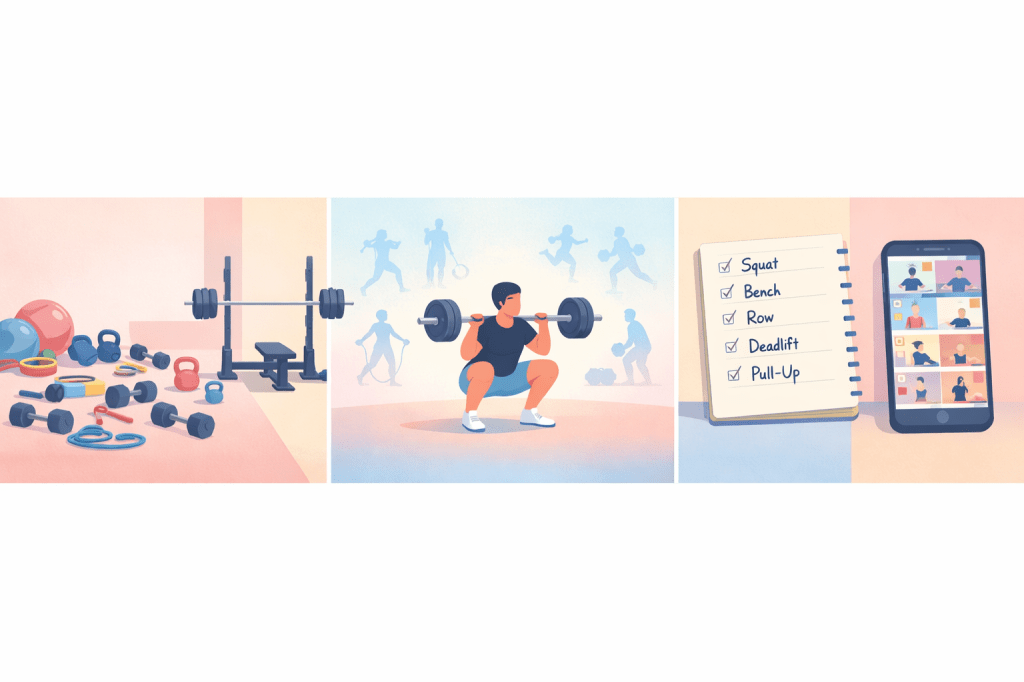
It’s a common assumption that a good workout must include a long list of exercises. Gym routines often feature twelve or more movements, each targeting a slightly different angle or muscle region. Variety is treated as a sign of a well-designed session.
But progress in training rarely comes from doing more exercises. It comes from improving performance in fewer ones.
The Misconception
The common belief is that variety automatically produces better results. The reasoning seems straightforward. More exercises should mean more stimulus. More stimulus should mean more muscle growth or faster fat loss. Changing exercises frequently is also believed to prevent plateaus.
Underneath this logic is a deeper assumption: that complexity equals effectiveness.
This idea sounds convincing for several reasons. Different exercises do stress muscles in slightly different ways. A bench press does not feel identical to a dumbbell press, even though both target similar muscle groups. Variety can make training more interesting. Doing the same thing repeatedly can feel monotonous. Social media workouts often reward novelty and creativity rather than long-term progression. A new exercise looks more impressive than doing the same lift with slightly more weight.
It becomes easy to conclude that constant change is necessary. That sticking with the same movements means you are not progressing. That if you are not rotating exercises regularly, you are missing out on potential gains.
The problem is that novelty and adaptation are not the same thing.
What Actually Drives Progress
Strength and hypertrophy depend heavily on progressive overload. For progress to occur, the body must experience a stimulus that gradually increases over time. That requires measurable improvement in performance. You add weight. You complete more repetitions. You handle the same load with better control or reduced rest periods.
This process works best when the movements remain stable enough to track. If you squat 100 kg for five reps this week, and 105 kg for five reps next week, you have clear evidence of progress. That clarity creates momentum. It tells you the program is working. It gives you a baseline to build on.
If exercises change every session, performance becomes difficult to measure. You might bench press one week, do dumbbell presses the next, and cable flies the week after. Each exercise uses different loading parameters, different stability demands, different skill requirements. There is no clear line of progression. Instead of building on previous efforts, each workout becomes a new starting point.
You are constantly adapting to new movement patterns rather than improving existing ones. That is not inherently bad for general fitness, but it is inefficient for strength or hypertrophy.
The Role of Skill Development
Skill development plays a role that many people overlook. Strength training is not only about muscles contracting. It also involves the nervous system learning how to coordinate force production. This is called motor learning.
Repeating movements improves efficiency, stability, and motor control. Your nervous system becomes better at recruiting the right muscles at the right time. You develop better proprioception, better balance, better timing. These adaptations allow you to produce more force with the same muscle mass.
This is why beginners often see rapid strength gains in the first few weeks of training, even before significant muscle growth occurs. They are not necessarily building muscle that quickly. They are learning how to use the muscle they already have more effectively.
Frequent exercise rotation interrupts this process before the skill can fully develop. Just as you start to get efficient at a movement, you switch to something else. You spend all your time in the early, inefficient phase of motor learning and never reach the proficient phase where real loading can occur.
Volume Distribution Matters
Training volume, the total amount of work performed, contributes to hypertrophy. But how that volume is distributed matters.
When effort is spread across too many exercises, each movement receives only a small portion of meaningful stimulus. You might do three sets of bench press, three sets of incline press, three sets of dumbbell flies, and three sets of cable crossovers. That is twelve total sets for the chest, but only three sets per exercise.
Compare that to doing twelve sets of bench press across the week, with variation in rep ranges and intensity. The total volume is the same, but the stimulus is concentrated. You are building skill, strength, and coordination in one movement while still accumulating sufficient volume for hypertrophy.
Instead of driving adaptation in a few lifts, the workload becomes diluted across many. You are doing a lot, but not enough of any one thing to produce meaningful change.
When Variety Actually Helps
Variety does have a place in good programming. It is not inherently bad. The issue is how and when it is applied.
Variety can reduce boredom. If you genuinely hate doing the same thing repeatedly, some rotation can improve adherence. A program you follow inconsistently is worse than a slightly less optimal program you follow consistently.
Variety can help manage overuse stress. If a particular movement causes joint discomfort when performed frequently, rotating in a similar but slightly different exercise can provide relief while maintaining stimulus.
Variety can address weak links. If your squat is limited by hip strength, adding specific accessory work for the hips makes sense. If your bench press stalls because of tricep weakness, adding direct tricep work is useful.
The problem is not variety itself. The problem is constant novelty. The problem is changing exercises before any real adaptation occurs. The problem is treating every session like it needs to introduce something new.
Purposeful variation supports progression. Random rotation often disrupts it.
What This Looks Like in Practice
In real coaching environments, this pattern becomes obvious. Clients who progress consistently tend to repeat core lifts for long periods. Their programs revolve around a small number of movements that appear week after week. Squats, deadlifts, presses, rows. The same exercises, session after session, month after month.
Loading increases gradually. Volume is structured across the week. Accessories change occasionally, but the foundation remains stable.
Programs built around endless exercise rotation rarely produce the same steady improvement. People feel busy. They feel like they are working hard. They accumulate fatigue and soreness. But when you ask them what they can do now that they could not do three months ago, the answer is often unclear.
They cannot tell you if they are stronger because they are never doing the same lift long enough to measure strength. They cannot tell you if they have built muscle because there is no consistent performance metric to track.
Most people do not plateau because they repeat exercises. They plateau because they never improve them. They chase novelty instead of progression. They confuse stimulation with adaptation.
What to Stop Doing
Stop chasing novelty every session. You do not need a new exercise every time you train. You do not need to constantly rotate movements to keep your body guessing. Your body does not need to be confused. It needs to be progressively challenged in a way you can measure.
Stop assuming soreness means progress. Soreness indicates an unfamiliar stimulus, not an effective stimulus. If you change exercises constantly, you will always be sore because you are always doing something your body is not adapted to. But soreness is not the goal. Adaptation is.
Stop rotating exercises before meaningful adaptation occurs. Give a movement at least six to eight weeks before deciding it is not working. Long enough to improve skill, build strength, and see whether you are actually progressing.
Stop building workouts primarily for entertainment. Training does not need to be exciting. It needs to be effective. If you are constantly seeking novelty to stay engaged, you are training for the wrong reasons.
What to Focus On Instead
Focus on a small number of compound movements performed consistently. Squat, deadlift, bench press, overhead press, rows, pull-ups. Not all of them every session, but rotated intelligently across the week. These movements provide the most return on investment because they involve multiple joints, multiple muscle groups, and allow for significant loading.
Track performance across weeks. Write down what you lift. How many reps. At what weight. Compare this week to last week. Compare this month to last month. If the numbers are not improving, your program is not working, regardless of how it feels.
Maintain a stable weekly structure. Monday might be squat-focused. Wednesday might be bench-focused. Friday might be deadlift-focused. The structure repeats. The lifts repeat. What changes is the load, the volume, and the intensity.
Introduce variation strategically rather than constantly. Add a new exercise when there is a clear reason. To address a weakness. To reduce joint stress. To provide novelty after months of the same routine. But not just because you are bored or because you saw something new online.
Progress becomes easier to measure when the foundation stays the same. You know where you started. You know where you are now. You can see the trajectory clearly.
The Identity Shift
This requires a shift in identity. From someone who collects workouts to someone who builds performance.
The person who collects workouts is always searching. Always looking for the next program, the next exercise, the next variation. They accumulate information but rarely apply it long enough to see results. They confuse activity with progress.
The person who builds performance picks a direction and stays with it. They commit to a program. They execute it consistently. They track progress. They make small, deliberate adjustments based on results, not feelings. They understand that repetition is not a flaw. It is a feature.
Effective programs often look simple on paper. The same lifts appear again and again. Squat, bench, deadlift. Week after week. Month after month.
What changes is not the exercise list. What changes is that the athlete gets better at them. The weight increases. The reps increase. The form improves. The efficiency improves.
That is progression. Not novelty. Not complexity. Not variety for its own sake. Just measurable improvement in fundamental movements, sustained over time.
That is what builds strength. That is what builds muscle. That is what produces results that last.

Leave a comment