
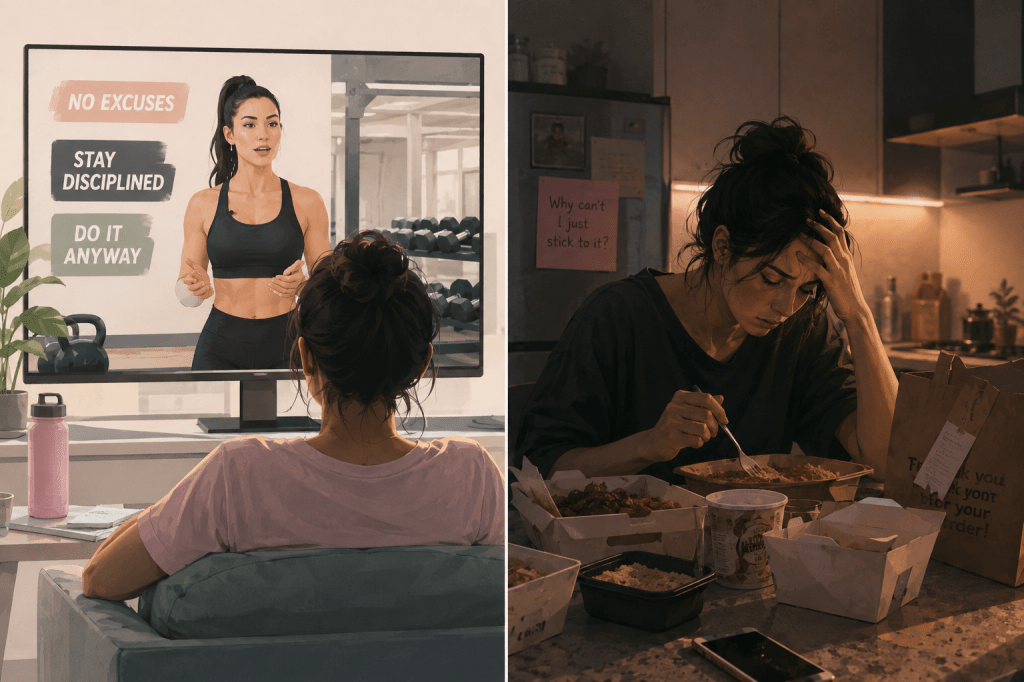
What Fitness Culture Tells You
Spend enough time in fitness spaces and a particular set of ideas starts to feel like common sense.
Discipline over motivation. Feelings are temporary. Emotions change, discipline does not. Stop waiting to feel ready. Stop letting your mood decide your actions. Motivation is a feeling, and feelings do not make progress. Only discipline does.
This messaging is everywhere. Coaches repeat it. Transformation accounts are built around it. It gets shared, saved, and printed on gym walls. And it is not entirely wrong. There is something real in the idea that behaviour cannot depend entirely on how you feel on a given day.
The problem is not that the message is false. The problem is what it implies.
If discipline is the answer and feelings are the obstacle, then the logical conclusion is straightforward: feel less, push harder, override the emotion, and execute the plan. Anyone who cannot do that consistently is simply not disciplined enough. The gap between knowing what to do and actually doing it becomes a character gap. A willpower gap. A question of how badly you really want it.
That framing is appealing because it is clean. It locates the problem clearly, offers a solution, and implies that success is always one decision away.
It also happens to miss the actual mechanism behind why most people struggle.
Telling someone to override their emotions without understanding what those emotions are doing is not a solution. It is a workaround that holds until the pressure is high enough. And for a significant number of people, it actively makes things worse, because it adds shame to a pattern that shame has never once resolved.
The information is not the problem.
Most adults trying to improve their health have already consumed years of advice. Calories, macros, training programs, sleep hygiene, habit stacking. The knowledge is widely available, frequently repeated, and reasonably well understood by the people who most need to apply it.
And yet behaviour still breaks down. Repeatedly, predictably, in ways that do not respond to more information or harder effort.
For some people, missing one workout is a minor disruption. They adjust and move on. For others, the same missed session triggers guilt, avoidance, and a week of disengagement. Some people eat one unplanned meal without consequence. Others find themselves in a cycle of overeating, restriction, and shame before the night is over.
The difference between these two responses is rarely nutritional knowledge. It is often something quieter and considerably more influential: the emotional patterns through which people process stress, failure, and discomfort.
Behaviour Is Emotional Before It Is Logical
The way a person learns to handle difficult emotions early in life tends to become the template for how they handle food, exercise, and self-regulation later.
This is not a claim that every dieting struggle traces back to childhood, or that emotional complexity can be resolved by recognising a pattern. That framing has been simplified beyond usefulness in online wellness spaces. Human behaviour is shaped by a wide range of factors, including sleep, stress, environment, culture, biology, and social conditioning, and any honest account of why people behave the way they do has to hold that complexity.
What is underappreciated, however, is how much emotional patterns shape the specific ways behaviour breaks down under pressure.
Children learn early whether emotions are safe to express, tolerate, or acknowledge. In some environments, discomfort is met with curiosity and reassurance. In others, it is dismissed, minimised, or responded to with criticism. Some children develop a working relationship with failure, learning that mistakes are recoverable and do not define them. Others learn that failure carries consequences, whether that is disappointment, withdrawal, or shame, and develop internal strategies to avoid that experience.
Those strategies do not disappear in adulthood. They migrate into new domains. And health behaviour, with its built-in cycle of effort, imperfection, and self-assessment, provides them considerable opportunity to appear.
Why Food Becomes a Regulation Tool
Food is one of the most accessible and immediate forms of emotional relief available.
Hyper-palatable foods in particular, do more than satisfy hunger. They produce rapid shifts in neurochemistry that temporarily interrupt emotional discomfort. Stress eating is not always about appetite. Sometimes it is a relief from pressure. Sometimes it is distraction from anxiety. Sometimes it is reward after a day that asked too much. Sometimes it is simply the one thing that feels uncomplicated when everything else does not.
Over time, the brain begins to associate emotional discomfort with eating as a resolution strategy. That association, reinforced across months and years, shows up later as emotional snacking, late-night overeating, difficulty stopping once started, or feeling out of control around food specifically during stressful periods.
This is precisely why discipline-based advice fails so consistently when applied to these patterns. Telling someone to simply stop binge eating addresses the behavior while leaving the mechanism entirely untouched. The eating is not the root problem. It is the most visible expression of a regulation strategy that has been in place, and functioning, for a long time.
Removing the behavior without understanding what it is doing creates a gap that something else will eventually fill.
When Exercise Becomes Tied to Identity
The same dynamic appears in how people relate to training.
A significant number of people do not exercise from a place of genuine self-care. They exercise from fear, shame, comparison, or the need to earn a sense of worth. That distinction matters more than it initially appears.
From the outside, fear-driven motivation can look like discipline. The person tracks everything. Never misses sessions. Pushes aggressively. Their consistency appears admirable. But the system underneath is inherently fragile, because it is sustained by pressure rather than by genuine integration.
When real life intervenes, as it always does, the cracks appear quickly. Stress increases. Energy drops. A session gets missed. And what follows is not the minor recalibration of someone with a stable relationship to their training. It is the emotional response of someone whose self-assessment has just been disrupted.
One missed workout becomes evidence of returning to an older, worse version of themselves. One difficult week becomes confirmation of a fear they have been outrunning. The behavior, the missed session, is not actually the problem. The meaning attached to it is what creates the collapse.
The Perfectionism Trap
Perfectionism operates through the same mechanism, and it deserves specific attention because it presents itself as a strength.
People who learned early that approval was contingent on performance tend to carry that framework into their relationship with health. Progress becomes emotionally loaded. The body becomes a measure of worth. Discipline becomes proof of something deeper about who they are.
That structure cannot survive contact with normal life for very long. And when it breaks, the fall is proportional to the height of the expectation.
Research on long-term behavior change consistently shows that flexible consistency outperforms rigid control. People who can absorb setbacks, adjust, and continue tend to sustain habits longer than those who rely on intensity and perfection as their primary operating mode. Ironically, some of the most visibly disciplined people are psychologically the most destabilized when their routine is disrupted, because the routine was never really about health. It was about maintaining a self-image.
The behavior looks strong until the moment it doesn’t. And then it tends to collapse completely.
What Traditional Approaches Miss
Many structured approaches to health and fat loss, including coaching models, are built on the assumption that compliance produces results and that pressure drives compliance. That can be true in the short term.
What pressure does not produce is sustainability.
A person motivated primarily by shame can deliver impressive numbers for a period of weeks. Underneath that performance, the emotional cost is accumulating. The system is running on threat, and threat is exhausting to maintain. Eventually it depletes, and what follows is not a gentle tapering off but a full withdrawal from the process.
This is not a failure of willpower. It is a predictable consequence of building a behavior system on an unstable foundation.
Effective support, whether from a coach or a self-directed process, tends to address things that have nothing to do with calorie knowledge. It builds emotional recovery capacity after setbacks. It develops tolerance for imperfection. It reduces the shame load attached to mistakes. It separates identity from performance, so that a difficult week is experienced as a difficult week rather than as evidence of personal inadequacy.
None of this is therapy. It is simply a more accurate model of how behavior actually works.
The Pattern That Holds Over Time
People who maintain consistent habits over years are not uniformly more motivated than those who do not. They are often just less emotionally reactive to disruption.
A missed workout registers as an adjustment rather than a verdict. An overeating episode generates information rather than self-punishment. A stressful week is experienced as temporary rather than catastrophic. The behavior returns more quickly after disruption not because the person is stronger, but because the disruption does not trigger an identity-level response.
That emotional stability changes the long-term picture considerably. Small deviations do not compound into extended disengagement. Setbacks do not accumulate into quitting. The process continues not because conditions are always favorable, but because the person has learned to stay in it when they are not.
That is a learnable capacity. It is not a fixed trait that some people have and others do not. It develops through repetition, through adjusting expectations, through building routines that can absorb imperfection, and through gradually changing the internal response to difficulty from collapse to recalibration.
What Needs to Change
Stop treating inconsistency as a motivation problem when the pattern is clearly emotional. More effort applied to the same underlying dynamic produces the same result with more frustration attached. Stop building routines that depend on perfect conditions to hold. They will break, and the manner in which they break will tell you more than the routine itself ever could.
Stop interpreting every setback as personal evidence. A difficult week is not a character assessment. An unplanned meal is not a moral failure. Treating them as such does not produce better behavior. It produces avoidance, shame, and withdrawal from the process.
What to Build Instead
Develop the capacity to return quickly after disruption. That is the actual skill. Not perfect adherence, but short, low-drama recovery. One bad meal followed by a normal next meal. One missed week followed by a normal next week. The gap between going off track and returning is where consistency is really built or lost.
Build routines with enough flexibility to survive real life. A plan that only works when energy is high and stress is low is not a sustainable plan. It is a best-case scenario.
Separate identity from performance. Progress is useful information. It is not a measure of worth. Building that separation, even partially, changes how setbacks land and therefore changes what happens after them.
Pay attention to the emotional function that food, exercise, or control is serving. Not to eliminate it, but to understand it clearly enough to respond differently when the pattern activates.
The Shift That Changes the Long-Term Outcome
From treating behavior like a moral test to understanding it as a system shaped by emotional patterns, environment, and learned responses.
From asking how to become more disciplined to asking what the current behavior is actually doing, and what would need to change for a different response to become available.
Lasting change is rarely built in moments of motivation. It is built in moments of stress, disruption, exhaustion, and discomfort, exactly the moments when old patterns are most likely to reassert themselves. What changes is not the absence of those moments. It is the response to them.
That response can be trained. The people who maintain health behaviors over the long term are not a different kind of person. They have usually just built a different relationship with imperfection.
And that is available to almost anyone willing to examine the pattern honestly rather than simply trying to overpower it.

Leave a comment