
Body recomposition is possible. It is also slow by design. If it feels fast, it is usually not recomposition.
The Misconception
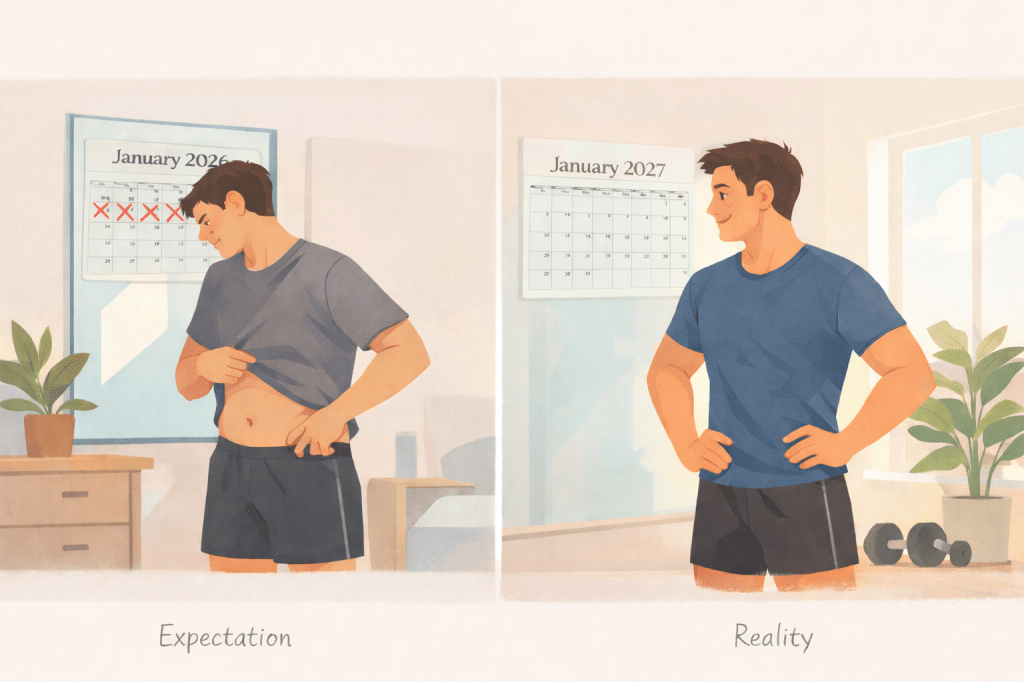
The common belief is that fat loss and muscle gain can happen rapidly together. That the body can aggressively burn fat while building muscle at the same time. That short-term visible changes, the kind you see in a few weeks, equal successful recomposition.
Underlying this is an assumption: more effort speeds up both processes simultaneously.
It does not.
Why It Sounds Logical
Beginners often see early changes. They lose some fat. They gain some strength. The body looks different. This creates the impression that recomposition happens quickly.
Marketing reinforces this. Programs promise to help you lose fat and gain muscle in weeks. Before-and-after photos compress months into dramatic comparisons. The message is clear: you can have both, and you can have them fast.
Scale weight fluctuations create false signals. You might lose two kilograms of fat and gain one kilogram of muscle, but the scale only shows a one-kilogram drop. You assume progress is slow when, in composition terms, it is actually significant.
Fat loss and muscle gain are often discussed together, so people assume they occur at the same rate. They do not.
What Science Actually Shows
Fat loss requires a calorie deficit. You must consume less energy than you expend. This signals the body to mobilize stored energy. Muscle gain requires sufficient energy and stimulus. You must consume enough to support tissue synthesis and provide the raw materials for growth.
Trying to maximize both at once creates competing signals. A deep deficit accelerates fat loss but limits muscle growth. A surplus supports muscle growth but slows or reverses fat loss. Recomposition sits in the narrow space between these extremes.
Recomposition is context-dependent. It occurs more effectively in beginners who have not yet adapted to training stimulus, detrained individuals returning after a break, and populations with higher body fat where energy reserves support muscle synthesis despite a deficit.
Even in these groups, rates are slow and controlled. A beginner might gain a few hundred grams of muscle per month while losing fat. That is real progress. It is also imperceptible week to week.
Muscle gain is a slow process. Even in ideal conditions, with a calorie surplus, optimal training, and adequate recovery, muscle tissue builds gradually. Progress is measured in months, not weeks. Fat loss can be faster. You can lose several kilograms of fat in a month under aggressive conditions. That mismatch creates unrealistic expectations. People expect muscle to appear as quickly as fat disappears. It does not.
The Trade-Offs
Aggressive fat loss produces faster scale change. You see results quickly. But it increases muscle loss risk, particularly if protein is inadequate or training stimulus is insufficient. Performance often declines. Strength drops. Recovery suffers.
Focused muscle gain produces better strength progress. You lift heavier. You recover faster. But fat reduction slows or stops entirely. If you are carrying excess fat, this approach may not align with your goals.
Recomposition offers a balanced approach. You lose fat slowly while gaining muscle slowly. Visual change is gradual. But the outcome is more sustainable. You build muscle you can keep while losing fat that does not return.
The trade-off is speed versus quality. Fast results often lack durability. Slow results, built with precision, tend to last.
Coaching Reality
In practice, clients chasing recomposition often lack patience. They expect visible change within weeks. When it does not appear, they assume the plan is not working. They change programs frequently, switching approaches every few weeks. This disrupts progress because adaptation requires consistency over time.
Scale obsession masks real changes. Someone might lose fat and gain muscle but see minimal scale movement. They interpret this as failure when it is actually success. Body composition improved even though weight did not drop dramatically.
Consistent moderate plans outperform aggressive ones. A small deficit, adequate protein, and progressive training sustained for months produces better outcomes than extreme deficits followed by binges or program-hopping.
Recomposition works best when it is not rushed. The slower the process, the more sustainable the result.
What to Stop Doing
Stop expecting rapid visible changes. Recomposition does not produce dramatic transformations in weeks. It produces subtle improvements over months that compound into significant change over a year.
Stop changing programs every few weeks. Adaptation takes time. Switching constantly prevents your body from responding fully to any single approach.
Stop relying only on scale weight. Weight is one metric. It does not distinguish between fat, muscle, water, or digestive content. Track measurements, progress photos, and performance.
Stop combining aggressive deficits with high expectations for muscle gain. A steep deficit prioritizes fat loss, not muscle growth. If recomposition is the goal, the deficit must be moderate.
What to Focus On Instead
Prioritize consistent training with progressive overload. Muscle growth requires increasing stimulus over time. Lift heavier, do more reps, or improve form under the same load. Progress must be measurable.
Ensure adequate protein intake. Protein supports muscle retention and growth, particularly in a deficit. Most people need more than they currently consume.
Maintain a small, controlled calorie deficit. Not aggressive. Just enough to create gradual fat loss without compromising recovery or performance. Typically 10 to 20 percent below maintenance.
Track strength and measurements. If your lifts improve and your waist shrinks, recomposition is happening regardless of what the scale says.
Extend your time horizon. Think in six-month and twelve-month blocks, not four-week sprints. Recomposition is a long game.
The Identity Shift
Move from “I want fast visible change” to “I am building a better body over time.”
Move from short-term results to long-term composition. The person chasing quick fixes will cycle through programs, diets, and frustration. The person committed to process will build something durable.
This shift is not motivational. It is strategic. Recomposition rewards those who can tolerate slow feedback. Those who can execute without needing weekly validation. Those who understand that the pace is not a flaw. It is the mechanism.
Closing
Recomposition is not inefficient. It is precise. The slow pace is not a design flaw. It is what allows the result to last.
Fat lost quickly often returns. Muscle built in a calorie surplus often comes with unwanted fat. Recomposition avoids both extremes by moving deliberately. It builds muscle you keep and loses fat that stays gone.
The body does not respond well to conflicting demands. It responds to consistency, patience, and intelligent programming. Recomposition provides all three, but only if you accept the timeline it requires.
If you cannot tolerate slow progress, choose a different approach. But if you value quality over speed, recomposition delivers. Just not this month. And that is the point.

Leave a comment